Procurement Process Acceleration. Can the CPO and CISO Speak with One Voice in the AI Era?
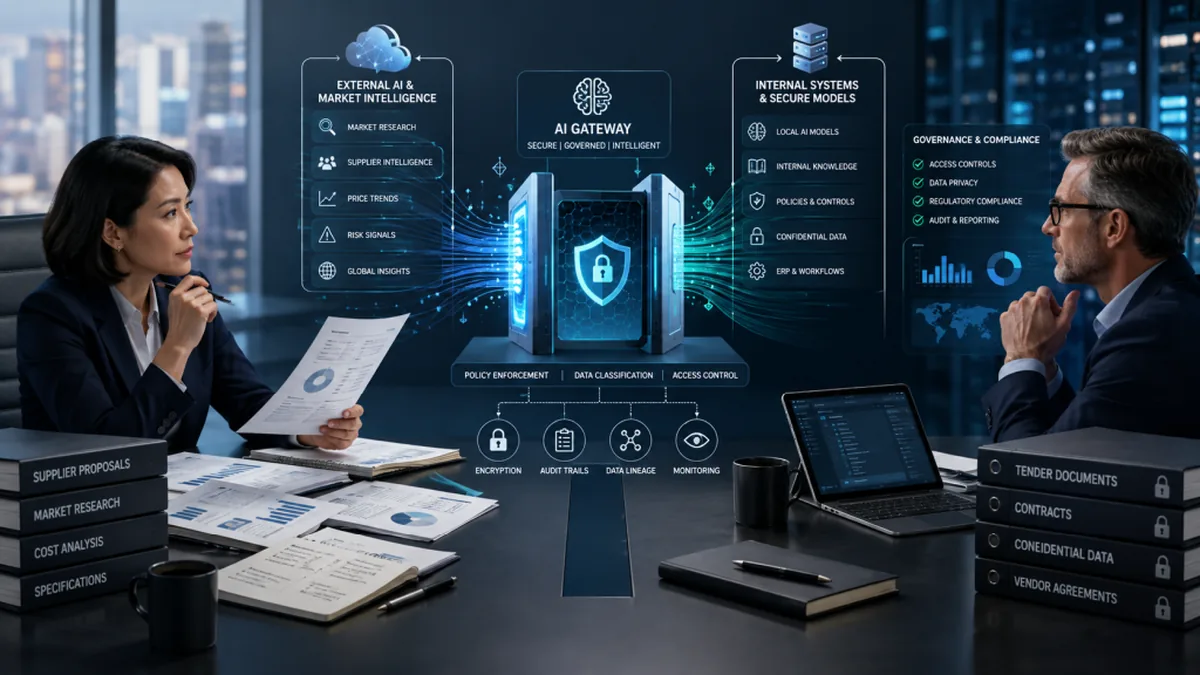
In most organizations, the conversation about AI in procurement begins with enthusiasm and ends with a veto. The Chief Procurement Officer (CPO) sees a tool that can research the market, estimate costs and prepare a realistic specification in minutes. The Chief Information Security Officer (CISO) sees tender data, bidders' trade secrets and personal data flowing into an external model over which the organization has no control. Both are right — and that is exactly why so many AI projects in procurement get stuck at the pilot stage, with nobody willing to approve them for production.
!Article cover about accelerating procurement processes with an AI Gateway
This conflict is especially sharp where the procurement process is subject to formal rigor: under public procurement law or restrictive corporate procedures. Every action must be documented, every decision assigned to a human being, and every breach of confidentiality carries legal consequences, not only reputational ones.
The paradox that neither a ban nor permission will solve
A complete ban on using external models does not eliminate the problem — it moves it into the grey zone. Employees will still paste fragments of documents into public chats, only without any control, logs or organizational awareness. Shadow AI is to procurement departments today what shadow IT was a decade ago — with the difference that a data leak into a model can be irreversible.
Uncritical permission, on the other hand, means that estimates, negotiation strategies and offer contents enter infrastructure whose location, retention and further use the organization does not control. For a public contracting authority, this is a direct route to breaching procurement rules; for a private company, to losing negotiation advantage.
The core of the problem is that both types of tasks are real and both are needed. Market research, tracking technological developments and creating state-of-the-art specifications — this is where the largest hyperscaler models are currently unmatched, and it would be wasteful not to use them. But offer analysis, estimates and procurement documents are material that must not leave a controlled environment.
This is not one problem to be solved with one model. These are two different operating regimes that must be separated architecturally.
- Architecture instead of compromise: AI Gateway. The answer is not choosing between power and security, but an intermediary layer that makes that choice anew every time — for each prompt, according to transparent rules. This is how the AI Gateway architecture works in the PROXY:AI ecosystem together with the TWIN:DESK platform. The principle is easy to describe and demanding to implement: the user works on one screen and does not need to be a data-classification expert to work safely. The gateway decides where a given prompt may flow.
- Hybrid access from one screen. Within one platform, the buyer uses external models where they gather market knowledge, compare technologies and build context, and internal local models where sensitive data is involved: offer contents, estimates and procurement documents. The boundary between these worlds is not a matter of user discipline or an internal policy nobody reads. It is enforced technically, in the gateway layer, before the prompt ever leaves the organization. The CISO does not have to trust people — it is enough to trust the architecture.
- Full legal compliance and auditability. In formal processes, it is not enough that AI helped — you must be able to demonstrate how it helped. PROXY:AI generates a non-repudiable evidence package for every interaction: what the input was, which model processed the prompt, which sources supported the answer, and who made what decision based on the result. This changes the status of AI in the organization — from a tool that must be hidden from an auditor into a tool that provides audit evidence. For public contracting authorities, this means compliance with public procurement requirements and EU AI Act restrictions; for commercial organizations, compliance procedures without slowing down work.
From secure access to your own assistants
The gateway solves the security problem, but by itself it does not yet accelerate work. True acceleration begins one level higher — where the procurement department stops being a consumer of a ready-made tool and starts building its own.
- Broad assistant creation. In TWIN:DESK, procurement teams build their own research agents in natural language — without developers, without an IT project and without waiting in a development queue. Such an agent tracks market developments in its purchasing category, prepares specifications reflecting the current state of the art and feeds secure internal knowledge bases with material for further work. Knowledge that previously lived in the heads of the most experienced buyers and disappeared when they left becomes an organizational asset — gathered in a controlled environment, versioned and available to the entire team.
- Democratization of automation. This brings us to a principle we consider critical for mature AI deployments: a language model should not do everything. Information developed in TWIN:DESK — specifications, analyses and market data — is made available to process systems that operate algorithmically, using classic deterministic methods of data processing and reporting. AI gathers and structures knowledge; hard rules drive the process. Where the outcome must be repeatable, auditable and compliant with procedure, there is no room for model non-determinism — and a well-designed system guards that boundary itself instead of leaving it to user intuition.
This division of roles has another often overlooked advantage: it makes the system cheaper and faster. A language model is used only where it brings real value — interpretation, synthesis and research — not for tasks that rules and workflows have handled very well for thirty years.
One voice instead of two monologues
Let us return to the question in the title. The CPO and CISO can speak with one voice — provided the conversation stops being about *whether* to use AI and starts being about *where* data flows and *who* is responsible for the decision.
A hybrid architecture with an AI gateway gives both sides exactly what they need: the CPO gets the power of the best models and a team that builds its own tools; the CISO gets a hard technical guarantee that sensitive data does not leave the controlled environment, plus an evidence package for every interaction.
For the organization, the effect goes beyond security alone: higher efficiency of procurement teams, better optimized logistics chains and real financial savings — achieved not despite the security department, but with its signature on the architecture.