Can AI-Generated Code Meet a Bank's Requirements?
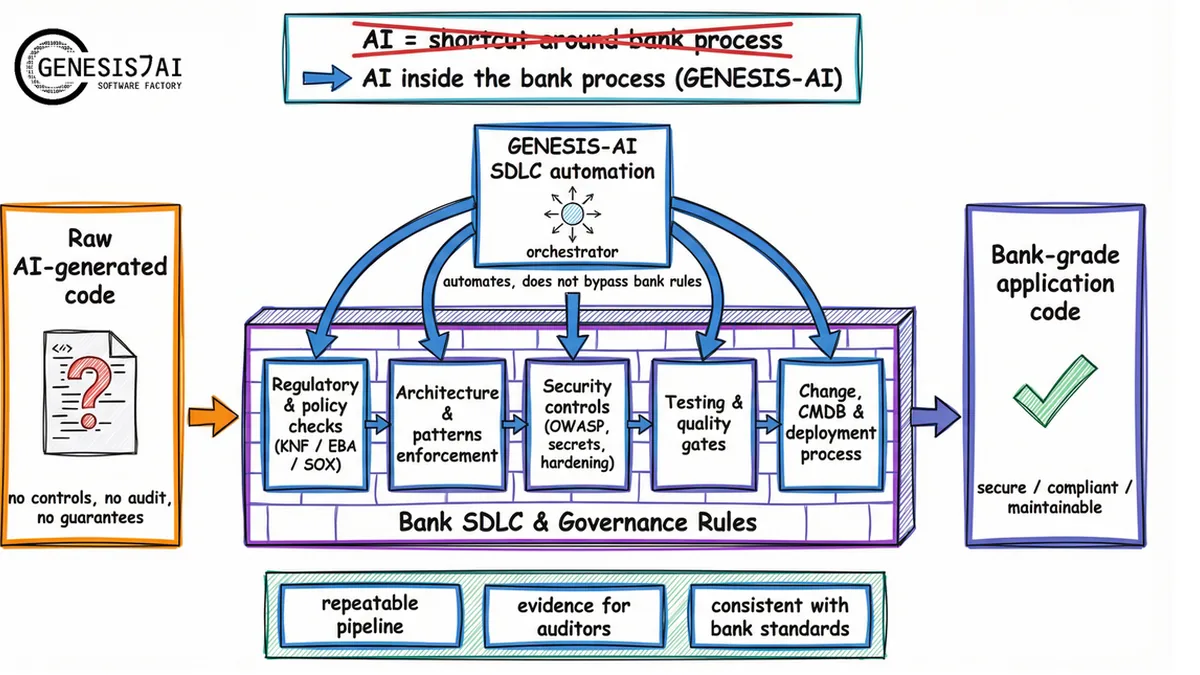
For most banks, the question is no longer whether to use AI, but how to do so without compromising security, compliance, and architecture. GENESIS-AI assumes that AI does not replace the software development process—it automates the entire SDLC in accordance with the rules defined by the bank.

What exactly must a "code for the bank" fulfill?
The bank's requirements for applications are much broader than "works in a test environment." Typically, they include:
- Compliance with regulations and guidelines (EBA, local supervision, guidelines on AI, cloud computing, outsourcing).
- Security standards: access control, encryption, auditing, vulnerability resistance (OWASP, SAST, SCA, dependency scanning).
- Bank architectural and technological standards: reference patterns, approved frameworks, integration methods, logging, observability.
Only code that meets this set of criteria is acceptable from a risk and compliance perspective—regardless of whether it was written by a developer or a platform such as GENESIS-AI.
Why is a "pure" AI code generator not enough?
A classic scenario: an analyst or developer asks the model for a piece of code, copies it to the repository, and... hopes that the tests will catch something. From the bank's point of view, this poses several problems at once:
- No audit trail: it is unclear where the code comes from, what hints were used, or whether external components with questionable licenses were used.
- Inconsistency with bank standards: the model does not recognize internal patterns, naming conventions, or architectural requirements, so it generates "nice" code, but not necessarily code that complies with internal rules.
- Security risk: AI easily replicates vulnerable patterns (e.g., incorrect validations, lack of permission restrictions, incorrect operations on confidential data).
That is why at GENESIS-AI we say it straight: a bare code generator is not a solution for a bank. What is needed is a platform that oversees the entire SDLC, not just one stage.
How does GENESIS-AI approach code for banks?
The GENESIS-AI approach is reversed: first the standard, process, and control, then automation. Key elements:
1. GENESIS-DOCU – a specification that AI understands and auditors accept
GENESIS-DOCU is a requirements documentation standard that serves as both material for AI and an artifact for auditing.
- A structured description of business requirements, product rules, non-functional requirements, and regulatory constraints.
- Clear indication of security requirements, login, data retention, integration with the bank's existing architecture.
As a result, when the GENESIS-AI multi-agent "team" designs architecture and generates code, it does not operate on the basis of general prompts, but on specifications that can be presented to risk, audit, and regulatory authorities.
2. Multi-agent SDLC – from requirements to containers
In GENESIS-AI, different agent "roles" are responsible for successive stages of the SDLC: architecture, backend, frontend, testing, security, and deployment.
- The agent-architect translates GENESIS-DOCU into an architecture that complies with the bank's standards (e.g., microservices, communication, integrations).
- Agent developers generate code in technologies approved by the bank, using predefined patterns.
- The test agent builds a set of tests (unit, integration, contract) and non-functional test scenarios.
- The security agent launches a security pipeline: SAST, SCA, dependency and configuration analysis.
Result: we do not have a single "AI code dump," but rather a complete set of SDLC artifacts that the bank and auditors know and understand.
3. Built-in quality gate instead of “trusting AI”
In GENESIS-AI, AI is the producer, but the process remains the gatekeeper:
- The code will not proceed if security tests or scanners detect a violation of the bank's policies.
- Every step is logged: code changes, agent decisions, test results, scan results—this is material for later audits and risk reviews.
- The bank can define and update quality and security rules itself, which constitute "policy as code" for the security agent.
This turns the question "Is the AI code secure?" into "Has the quality pipeline been configured correctly and run without errors?"
What about regulations and the AI Act?
Regulators are not banning the use of AI in banks—they expect it to be implemented in a controlled manner, with appropriate risk management, transparency, and oversight.
- The EU AI Act and EBA guidelines require, among other things, the classification of high-risk systems, documentation of their operation, monitoring, and control.
- A platform such as GENESIS‑AI facilitates the delivery of the required documentation: from GENESIS‑DOCU, through architectural artifacts, to logs from performed tests and security checks.
From the bank's perspective, it is important to be able to show how we control AI, not just how innovative it is.
Answer: When is AI code truly "bankable"?
AI-generated code may meet the bank's requirements provided that:
- It is based on formal, auditable specifications (e.g., GENESIS-DOCU) rather than free prompts.
- It is part of an automated but tightly controlled SDLC with testing, security scans, and quality gates.
- Every decision and change has an audit trail that can be presented to the risk department, audit, and regulator.
In this sense, GENESIS-AI does not respond with "yes, AI will write code for the bank," but rather "yes, the bank can have a fully automated software factory that produces code that complies with its own standards and regulations."