AI Software Factory Is a Critical Technology for the EU Economy - Part 1/5
GENESIS-AI is a research project in the inLABs programme. The capabilities described are research goals, not an available product. Project status: inLABs
By 2026, AI will no longer be a technological novelty but will have become infrastructure and a geopolitical factor influencing labor markets, energy, security, and the balance of power between states and corporations. In such a landscape, what counts are solutions that can translate the capabilities of AI into real value in a controlled and compliant manner, rather than merely demonstrating technological superiority.
The AI software factory as a critical technology
GENESIS-AI project targets in numbers (to be confirmed by the research):
:::metric-list
- a reduction in the time needed to produce a typical web application prototype from approximately 180 days to 7 days,
- a reduction in unit cost from PLN 300,000 to approximately PLN 15,000 (a reduction of 90-95%),
- a reduction in the number of specialists needed for a project from 5-7 people to a duo consisting of an analyst and a technical person supervising the work of agents,
- no vendor lock-in — generating complete, readable code in standard technologies (Python, C, SQL, popular web frameworks), with the possibility of maintenance by any team,
- design in line with GDPR, NIS2, DORA and the AI Act, and on-premises or EU-cloud-only operation
Five arguments in five parts
Literature and reports on AI increasingly emphasize the transition from individual tools to agent-based systems that truly change the productivity, resilience, and digital sovereignty of the economy. The GENESIS-AI research project is a response to this shift — it aims to create a European, sovereign software factory based on multi-agent AI systems, designed in line with the AI Act and other EU regulations.
In five parts we set out why we run the GENESIS-AI project and what an AI software factory could mean for the EU economy:
- Part 1 — critical technology
- Part 2 — innovation, higher productivity, and lower costs
- Part 3 — digital sovereignty and strategic technological autonomy
- Part 4 — leveling the playing field for SMEs and startups
- Part 5 — Catalyst for a sustainable and resilient digital economy
Part 1/5 - Critical Technology for the Modern Economy [AI Software Factory Is a Critical Technology for the EU Economy]
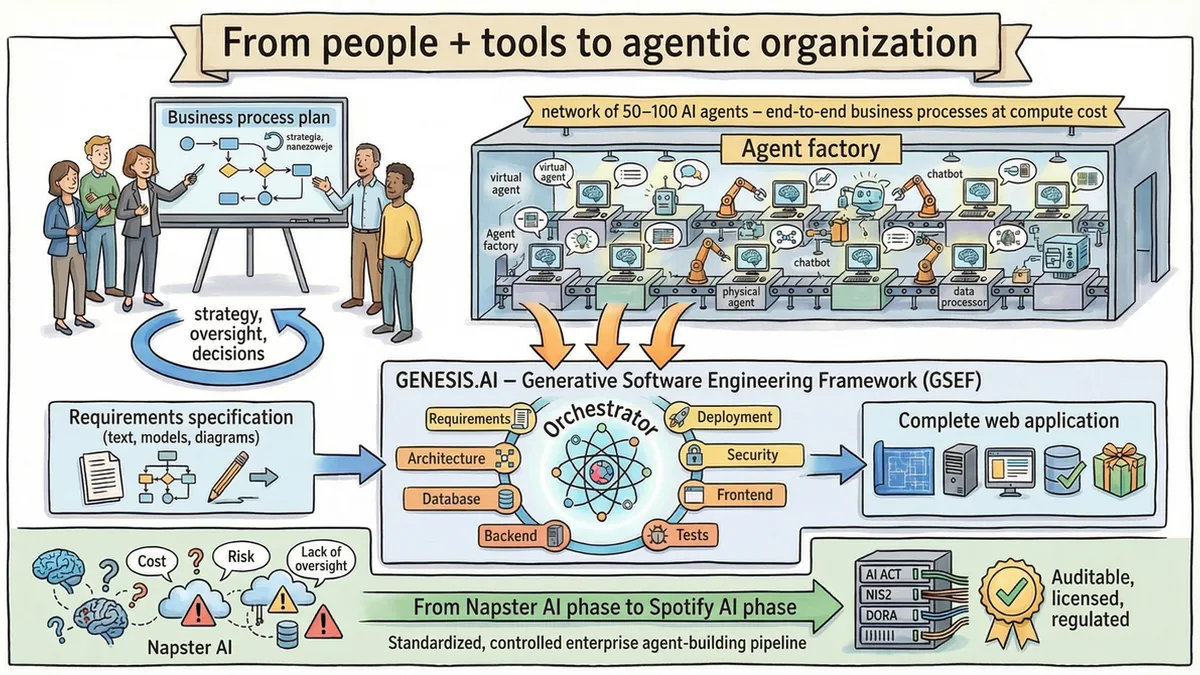
More and more analyses are discussing the advent of agentic organizations - companies where people work side by side with virtual and physical AI agents, and entire business processes are handled by networks of agents at a marginal cost close to the cost of computation. There are already reports of cases in which 2-5 people supervise "factories" of 50-100 agents performing complex end-to-end processes, from customer onboarding to closing the books, while humans remain above the loop, correcting and setting the direction rather than performing every operational task.

The GENESIS-AI project fits this trend: rather than another developer assistant, it assumes a multi-agent system of specialized agents (requirements analysis, database, backend, frontend, testing, security) with a central Orchestrator. At the heart of the project is the Generative Software Engineering Framework (GSEF) — a framework meant to take requirements specifications (text, models, diagrams) and systematically convert them into a complete web application: architecture, backend and frontend code, database schema, test suite, and deployment packages.
The debate on "agents as the next frontier" emphasizes that the transition from knowledge tools to systems capable of independently planning, dividing work into subtasks, and executing complex workflows will be the next wave of generative AI value. The explosion of agents, Claude Code, swarm solutions in IDEs, and corporate agent tooling has shown that systems that independently design, write, and run complex software already exist, but suffer from cost, security, and oversight issues. The GENESIS-AI project aims to address these challenges in one of the hardest areas — generating complete IT systems rather than simple tasks. Such a factory would be a critical technology in AI and software engineering, developed at the source rather than merely consuming other people’s models.
The world is moving from the "Napster phase of AI" - chaotic, often unregulated use of models - to the "Spotify phase," where regulated, licensed, and auditable use of AI is becoming crucial. This shift is reflected in European regulatory policy (AI Act, NIS2, DORA), which requires AI systems to be transparent, supervised, and auditable throughout their entire lifecycle. The GENESIS-AI project assumes a standardised, controlled pipeline for building enterprise agents — each agent is to have a defined scope of permissions, security tests, emergency scenarios, and a full audit trail.
In this sense an AI software factory is a critical technology for the EU — and that is how we see the direction of the GENESIS-AI project: an AI system developed in the EU, meant to strengthen the value chain in AI algorithms and meet the AI Act’s requirements for security, oversight and transparency. in the area of "artificial intelligence algorithms" and addresses the AI Act's requirements for security, oversight, and transparency.