Banking-Grade AI Code: The 9-Layer Security Pipeline
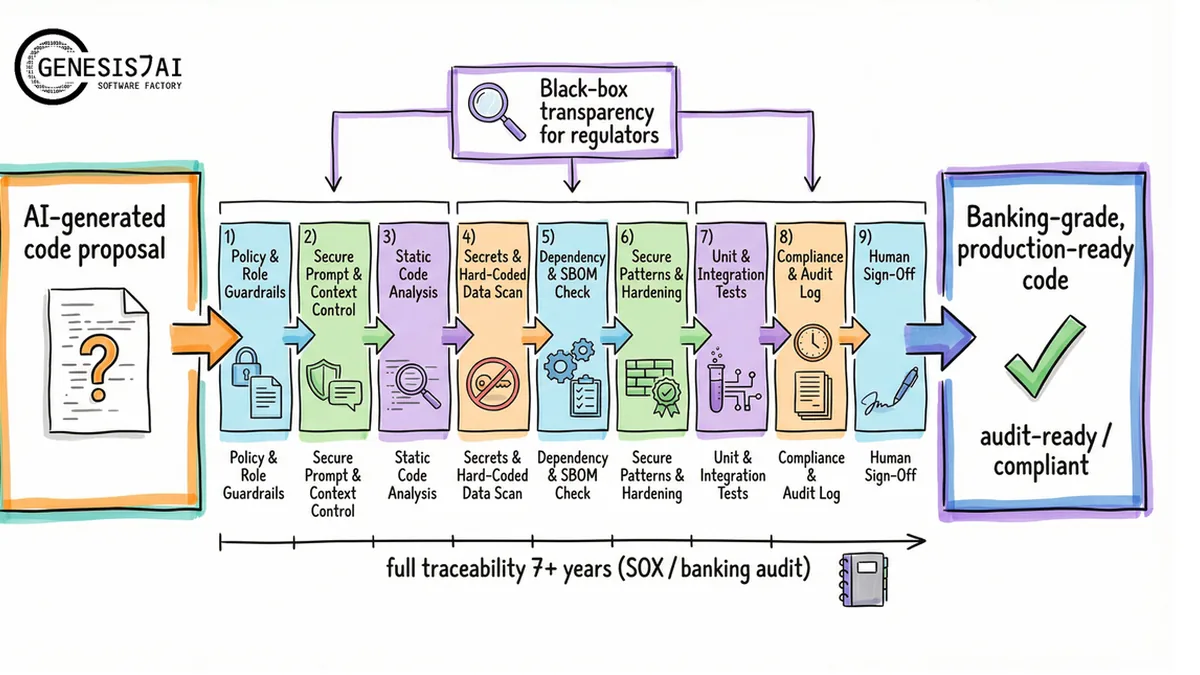
Black-Box Transparency: How Multi-Layer Validation Enables Regulatory Trust
Banking regulators confront a fundamental challenge with AI code generation: how to trust software whose creation operates as a black box. Generic AI assistants provide no audit trail, no compliance verification, and no explanation of security decisions, yet banking requires comprehensive documentation of every software change, with tamper-proof audit trails retained for seven years under SOX. Purpose-built AI platforms resolve the black-box problem through nine-layer security validation pipelines that subject every code generation request to independent validation stages, producing zero critical vulnerabilities on first-pass generation while automatically generating the audit documentation banking regulators require. The architectural innovation: transforming AI code generation from an opaque productivity tool into a transparent, verifiable, auditable platform that meets the highest regulatory standards.

The Black-Box Challenge: Why Generic AI Fails Audit Requirements
Traditional AI coding assistants operate as regulatory black boxes. GitHub Copilot generates code through neural network transformations, providing no explanation of security decisions, no compliance mapping, and no audit trail of validation steps. The model generates code based on patterns learned from public repositories - 39% of which contain vulnerabilities, according to a 2024 Gartner analysis - with no mechanism to verify SOX segregation of duties, PCI DSS secure coding standards, or DORA change management requirements.
This opacity violates banking audit principles. SOX requires documented internal controls over financial systems. DORA Article 9 mandates documented change management with recorded testing, assessment, approval, implementation, and verification. PCI DSS Requirement 6.2 requires evidence of secure development practices. Generic AI assistants provide none of this documentation - no audit trail captures why specific code patterns were chosen, which security controls were considered, how code maps to compliance requirements, or whether vulnerabilities exist. The 6.4% secret leakage rate in AI-enabled repositories - 40% higher than average - demonstrates how black-box AI introduces compliance risks.
The 9-Layer Security Pipeline: Defense in Depth
Purpose-built AI platforms resolve the black-box problem through nine independent validation stages, each generating audit evidence.
:::layer Layer 1: Intent Analysis & Regulatory Scope - NLP analyzes developer requests to extract functional requirements and identify regulatory implications. Output: a structured requirement specification with compliance frameworks.
:::layer Layer 2: Security Pattern Selection - Selects mandatory security patterns from a curated library based on regulatory scope. For credit card processing: input validation, AES-256 encryption, TLS 1.3, tokenization, role-based authorization, and audit logging. The AI model cannot generate code that violates selected patterns.
:::layer Layer 3: Secure Code Generation - The core AI model generates code with intrinsic security controls. Database queries use parameterized statements, authentication implements bcrypt hashing, and PII handling applies encryption and access controls.
:::layer Layer 4: Static Analysis (SAST) - Generated code undergoes static analysis (SonarQube, Checkmarx), validating it against the OWASP Top 10, CWE Top 25, and PCI DSS-specific requirements.
:::layer Layer 5: Dependency Analysis (SCA) - Analyzes third-party libraries for vulnerabilities using Snyk or OWASP Dependency-Check. Validates them against organizational approval whitelists.
:::layer Layer 6: Compliance Mapping - Verifies that generated code satisfies all regulatory requirements. Maps code elements to compliance obligations and generates a compliance matrix for audit documentation.
:::layer Layer 7: Dynamic Analysis (DAST) - Deploys to an isolated testing environment for runtime validation using OWASP ZAP or Burp Suite. Tests authentication bypass, session hijacking, CSRF, input fuzzing, and API abuse.
:::layer Layer 8: Audit Trail Generation - Compiles comprehensive documentation from all layers, formatted to directly support SOX, PCI DSS, and DORA audits.
:::layer Layer 9: Human Review & Approval - The final layer requires human judgment for deployment authorization. High-risk code requires multiple reviewers. It enforces SOX segregation by preventing developers from approving their own code.
Black-Box Transparency: Architecture for Trust
The platform operates through specialized AI agents (coordination, requirements, security, generation, validation, testing, documentation, approval) communicating through a central knowledge graph that maintains structured relationships between code patterns, security controls, regulatory requirements, and validation results.
Critical distinction: while AI models operate as neural networks (inherently black boxes), the platform architecture provides complete transparency through validation layers. Every security decision, compliance mapping, and validation result generates audit evidence. Code generation transforms from an opaque transformation into a documented, verifiable, auditable workflow.
Integration with enterprise security tools occurs through standardized APIs: SonarQube scans via REST API, Snyk dependency scanning, and OWASP ZAP dynamic testing. Approval workflows integrate with enterprise identity management (Active Directory, Okta, Azure AD), enforcing role-based access controls and segregation of duties. All validation results, approval actions, and deployment events are logged to immutable audit trails using blockchain or tamper-proof storage, ensuring seven-year SOX retention with cryptographic verification.
Strategic Conclusion: Architecture as Competitive Advantage
Banking cannot accept black-box AI code generation. Regulatory requirements demand comprehensive documentation, independent validation, and tamper-proof audit trails. Generic AI assistants designed for productivity rather than compliance create banking compliance challenges rather than resolving them.
The 9-layer security pipeline demonstrates how purpose-built platforms transform AI code generation from an opaque productivity tool into a transparent, auditable, compliant software development platform. Organizations implementing multi-layer validation achieve zero critical vulnerabilities on first-pass generation, a 60-75% reduction in compliance overhead through automated documentation, and an 80% acceleration in audit preparation through native audit trail generation.
Technical architecture determines regulatory viability. Organizations selecting AI platforms based on productivity metrics rather than compliance architecture face extensive manual documentation overhead and regulatory risk. Those implementing compliance-first architectures with multi-layer validation redirect compliance resources to innovation while establishing structural advantages that competitors cannot rapidly replicate.
Technical Recommendation
Evaluate AI code generation platforms based on architectural transparency - the number of independent validation layers, compliance pattern library coverage, audit trail automation, and enterprise security tool integration. Demand proof of zero critical vulnerabilities on first-pass generation and comprehensive documentation auto-generation supporting SOX, PCI DSS, and DORA audit requirements.
:::note Disclaimer:** Data presented in this brief (including cost reduction, velocity metrics, and error rates) are based on GENESIS-AI internal pilot simulations and aggregated, anonymized test scenarios. Actual results in client production environments may vary depending on infrastructure and process specifics. This material is for informational purposes only.