Digital Succession: How to Save Polish IT Architecture from the “Silver Tsunami”
SAVANT-AI and GENESIS-AI are research projects in the inLABs programme. The capabilities described are research goals, not an available product. Project status: inLABs
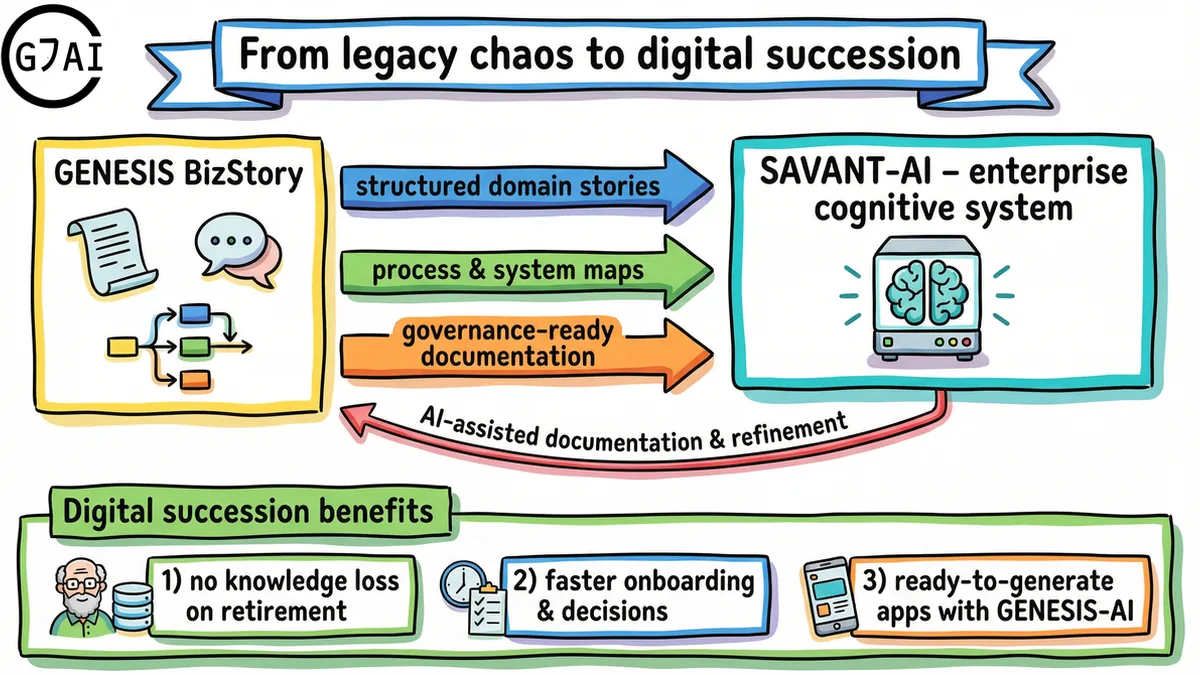
Digital succession is not just about recording the knowledge of departing experts in successive documents. It is the process of building a lasting, sovereign “organisational brain” that understands this knowledge and uses it every day, and a digital workshop that systematically captures, structures and turns it into working applications. We research both in the SAVANT-AI and GENESIS-AI (GENESIS-BIZSTORY) projects.

The legacy of Poland’s 2007–2013 digitalisation
Poland's computerization experienced its golden age in 2007–2013. Thanks to unprecedented support from European Union funds (mainly under the Innovative Economy Operational Program), the foundations of a modern state infrastructure were laid at that time. It was then that gigantic projects were implemented, revolutionizing the relationship between citizens, businesses, and government agencies. The most important implementations of that period include:
- Comprehensive Computerization of the Customs Service (e-Customs program): implementation of systems such as Celina, NCTS, and e-Export, which completely automated trade with third countries.
- Construction of the ePUAP Platform: aimed at creating a single window for public administration services.
- Modernization of state registers: including work on the PESEL2 system and projects related to the Digital Map of the Country.
- Systems supporting the Social Insurance Institution (ZUS) and the National Health Fund (NFZ): powerful databases that still form the backbone of the Polish insurance and healthcare system.
The “silver tsunami”: system knowledge is retiring
The generation of engineers, analysts, and architects who designed these multi-layered architectures is now on the verge of retirement. This phenomenon, known as the "silver tsunami," poses a critical strategic risk: along with the experts from the organization, unique, often unwritten knowledge about processes, relationships between modules, and the specifics of *legacy* systems is leaving.
SAVANT-AI: an “institutional brain” research project
The only effective way to stem this drain of expertise is to build a sovereign knowledge resource that will take over the know-how from departing specialists and make it available in a form that is useful for operations and management. We research a solution in the SAVANT-AI project — a sovereign Enterprise Cognitive System meant to act as the “brain of the institution” and run locally within the organization's infrastructure. Instead of another document repository, it is meant to create a secure, isolated intelligence layer above existing systems, and gather knowledge about business processes and the IT systems that support them.
GENESIS-BIZSTORY: expert knowledge as a digital asset
GENESIS-BIZSTORY is meant to be the key link. It was first intended to collect requirements for new applications in the GENESIS-AI project, but we see strong potential for legacy systems: it is meant to capture knowledge directly from employees
Data collected in GENESIS-BIZSTORY would be a unique input of the highest substantive value – it is a direct record of the experience of experts and the real processes of the organization. This resource is meant to fine-tune the models in SAVANT-AI so that the algorithms stop being merely general language models and become specialized experts who perfectly understand the specifics of a given institution. The same structured requirements could be used by GENESIS-AI to generate new production applications that gradually replace or complement legacy systems, closing the digital succession chain: from knowledge, through decisions, to working software.
Such “informing” of models is meant to let SAVANT-AI answer accurately questions about niche aspects of legacy systems and proactively support decision-making processes based on the company's historical experience.
Combining SAVANT-AI and GENESIS-BIZSTORY is meant to give companies their own sovereign knowledge, so that even through generational change and the retirement of key employees, employees’ experience stays in the organisation as a permanent, intelligent, and constantly evolving digital capital.
Who is this digital succession model for?
- For ministries, central offices, and institutions that built large systems co-financed by the Innovative Economy Operational Program (POIG) between 2007 and 2013 and are now facing the departure of key architects and analysts.
- For state-owned companies, critical infrastructure operators, and the financial sector, which cannot transfer data and processes to the public cloud, but at the same time need to accelerate their digital transformation.
- For large industrial and logistics organizations that struggle with the "physics of data" – dispersed ERP, MES, WMS, or CMMS systems and the lack of a single, consistent source of truth about processes.
By design, SAVANT-AI is meant to be the organisation’s sovereign brain, GENESIS-BIZSTORY its digital memory and GENESIS-AI the workshop that builds new applications on that memory.