How to build a Sovereign SAVANT-AI Competence Center (ECS) in 12 months
SAVANT-AI is a research project in the inLABs programme. The capabilities described are research goals, not an available product. Project status: inLABs
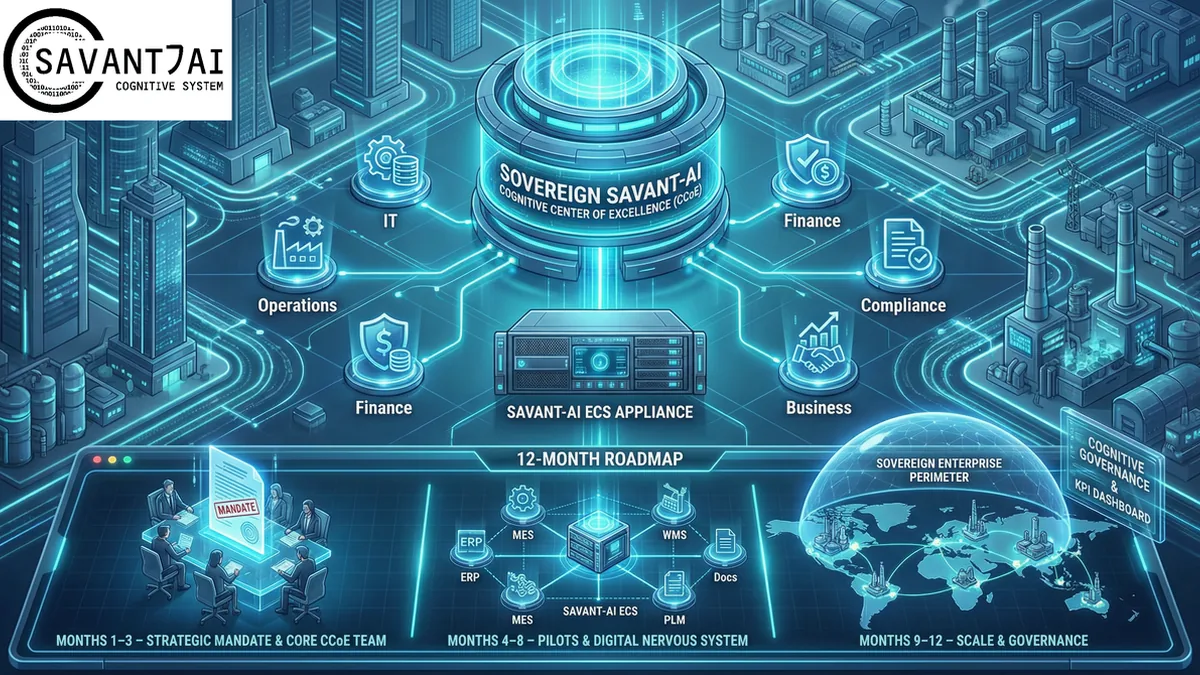
An AI competence centre is not another application but an organisational capability. In the SAVANT-AI research project we explore how to support it with technology. Building it requires a Cognitive Center of Excellence (CCoE). The roadmap below defines the process of transforming an organization into a cognitive organism, from a strategic mandate to global intelligence scaling.

Months 1–3: Strategic Mandate and Core Team Assembly (CCoE)
At this stage, it is crucial to clearly embed AI in the company’s strategy.
- Board mandate: Appoint a Chief AI Architect with the authority to break down information silos.
- Inventory and Extraction of the Initial Corpus: Commence mass collection of “raw knowledge” from DMS systems and PDF repositories. This is the stage of building the foundation for the so-called Cognitive Knowledge Corpus.
- Formation of the Core Team (CCoE Core): A group of 6–8 specialists (405B Architect, TEE/Sentinel Engineer, MCP Developer, HitL Coordinators).
- Silo Audit: Identify Model Context Protocol (MCP) endpoints for ERP and PLM systems.
Months 3–6: Operational pilot and calibration of the “Core of Truth”
The second quarter is the “Data Refinery” phase — transforming raw information into a structure understandable to the Super Agent.
- Building the “Golden Dataset”: Expert Clusters develop a set of 500-1000 critical “Question-Answer” pairs (Ground Truth) that will be used to rigorously test the accuracy of the system.
- Infrastructure: setting up an on-premises AI environment, air-gapped where required.
- Indexing and Scrubbing: Activation of anonymization and semantic cleaning modules for the data corpus.
- Calibration Loop (RLHF on-premise): Experts verify the first syntheses, “polishing” the model’s substantive weights.
Months 6–9: Formalization of governance and cognitive standards
CCoE transitions to continuous oversight of knowledge appreciation.
- Continuous Ingestion: Launch of automatic data pipelines that feed new facts from transactional systems into the system in real time.
- Implementation of the Permissions Matrix: Implementation of RAdAC and MAC models.
- Elimination of AI Sprawl: Phasing out Shadow AI in favor of sovereign orchestration.
- Activation of Sentinel Audit: Independent, redundant real-time oversight of AI processes.
Months 9–12: Horizontal scaling (Cognitive Clustering)
Expansion of intelligence across the entire GMLC global structure.
- Scaling: extending infrastructure to further locations and sharing insights between them.
- Cognitive Product Catalog: Launch of the Cameleoo interface for 80% of knowledge workers.
- Knowledge Appreciation: The moment when the system begins to independently identify “gaps in the knowledge base” and asks experts to fill them.
:::note
Strategic Note 1: Definition and rigor of RLHF on-premise
RLHF (Reinforcement Learning from Human Feedback) run on-premises is one of the pillars of the competence centre’s sovereignty:
- Digital mentoring: Allows you to “polish” the model’s intelligence through direct substantive corrections made by Expert Clusters. The model learns the operational dialect and the organisation’s ontology.
- Intellectual capital protection: All substantive corrections never leave the company’s perimeter, which prevents competitors from learning from your know-how.
:::note
Strategic Note 2: Building a Cognitive Knowledge Corpus
Building a training data corpus is not a one-off import but a process of Fact Engineering:
- Semantic Extraction: The system not only “reads” PDF files, but breaks them down into atomic facts, assigning them tags of sovereignty and strategic importance.
- Truth Hardening: The CCoE team, together with experts, creates a “Golden Corpus,” which serves as a benchmark for Objective Truth. This is what the system uses to learn what is considered an indisputable fact in the organisation.
- De-identification: Before any fragment of the corpus reaches the inference layer, it passes through an anonymization filter, protecting personal data in accordance with the GDPR while maintaining the full technical value of the information.