How to define requirements for an application in GENESIS-AI
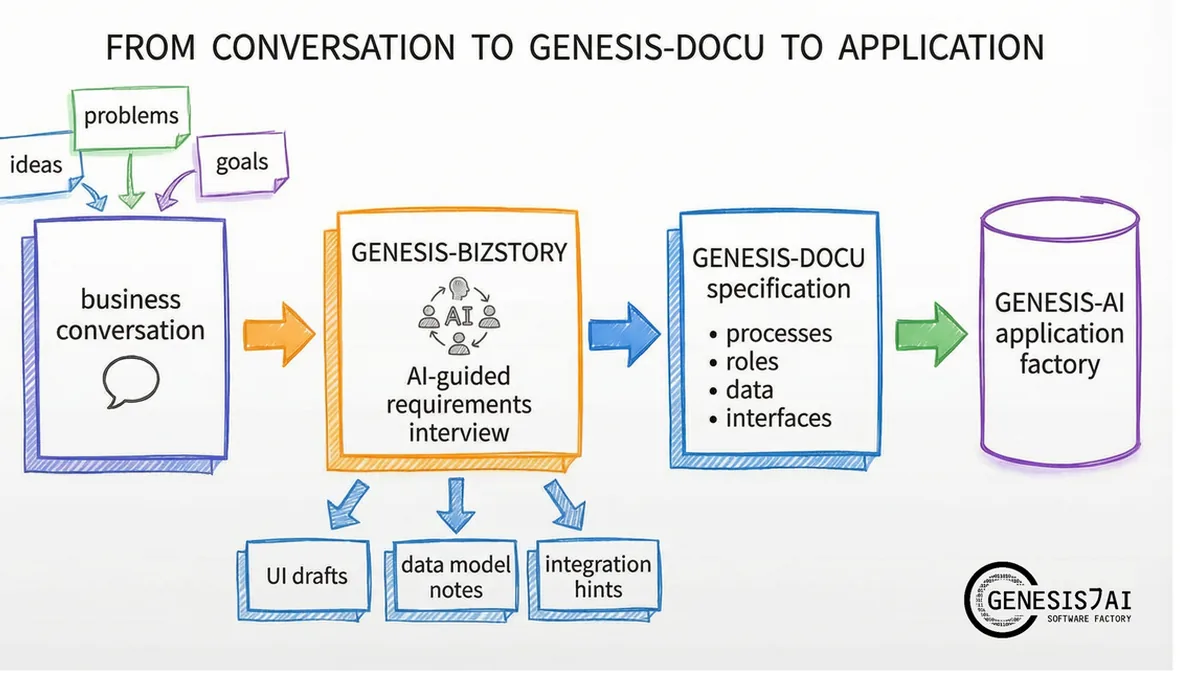
GENESIS-AI is a research project in the inLABs programme. The capabilities described are research goals, not an available product. Project status: inLABs
In most IT projects, the greatest amount of time and risk is involved not in the programming itself, but in defining and maintaining requirements. The GENESIS-AI project aims to simplify this stage: from a natural-language conversation to complete GENESIS-DOCU documentation, meant to fuel the application factory.

Why classic specifications are no longer sufficient
In traditional projects, the biggest challenge is not the programming itself, but creating a specification that:
- is understandable to both business and technical teams,
- remains current throughout the project,
- allows for quick verification of whether the system being built actually solves the business problem.
Extensive Word documents, Excel spreadsheets with lists of requirements, and scattered technical documentation mean that:
- the definition of requirements is costly and prone to errors,
- changes are implemented slowly and often “get lost” along the way,
- it is difficult to maintain consistency between what has been agreed and what has actually been implemented.
As a result, the specification becomes a static document rather than a living model of the system that can be automatically converted into a working application.
When designing AI-based systems, all three areas — analysis, development, and testing — should be supported by intelligent tools as much as possible. Otherwise, we are only adding a layer of complexity.
GENESIS-AI: the concept — from conversation to finished application
There are various application generation environments available on the market today, but most of them focus on the code itself, attempting to reduce errors resulting from manual programming with fragments of generated software. The GENESIS-AI project goes a step further: it assumes not only code generation but a comprehensive application production platform — from defining requirements, through architecture design, to generating a complete, containerised application.
The key is how we describe the requirements at the input stage. The project aims to simplify this process in two ways:
- the business is to talk about the system in natural language, about the system in natural language,
- conversations are to be automatically translated into structured GENESIS-DOCU documentation into structured documentation in the GENESIS-DOCU standard, which becomes the “fuel” for the application factory.
How to minimize the risk of inaccurate specifications
GENESIS-AI assumes that, in order to reduce the risk of inaccurate specifications and limit the cost of their creation, it is worth:
- reducing the analysis to defining requirements in natural language,
- shortening the specification creation process with the help of AI agents,
- quickly sharing prototypes — primarily UI — for evaluation by the business,
- validating requirements and creating measurable indicators of their quality.
This is where GENESIS-BIZSTORY comes in — a mechanism of the GENESIS-AI project meant to translate conversations into precisely described requirements.
GENESIS-BIZSTORY: defining requirements in natural language
**GENESIS-BIZSTORY is meant to be an AI-supported conversational interface that guides the team through defining requirements. The project assumes several modes tailored to the complexity of the solution:
- Conversation with an assistant in natural language – for the simplest applications (e.g., MVP), where the most important thing is to quickly move from an idea to a working version.
- Moderated conversation – for simpler systems where additional control over selected features (e.g., roles, permissions, integrations) is needed.
- Moderated business conversation – for more complex applications where requirements must be specified in great detail.
Moderation means that specialised AI agents responsible for various aspects of the system are to be involved in the process, including:
- user interface (UI),
- integrations,
- data model,
- testing.
These agents ask clarifying questions, detect contradictions, and ensure the consistency of requirements at the discussion stage, before application generation comes into play.
In moderated mode, the agent responsible for the UI can also present screen prototypes on an ongoing basis — without fully generating the application — which allows for faster feedback collection and avoids situations where the user “sees” the system for the first time only at the acceptance testing stage.
From conversation to the GENESIS-DOCU standard
Each of the modes described is meant to lead to one goal: the creation of a precise and structured description of the application. The final shape of the solution depends on the detail of the conversation and the selected mode of operation, and the whole can be further enriched by using the GENESIS-DOCU metalanguage.
GENESIS-BIZSTORY is meant to automatically produce documentation compliant with the GENESIS-DOCU standard – a consistent description of processes, roles, data, and interfaces that:
- is readable for business, analysts, and architects,
- can be iteratively developed and improved,
- is meant to be a direct prompt for generating a complete application in GENESIS-AI.
Requirement validation is meant to continue during application generation: the platform is to flag inconsistencies, deficiencies, or potential risks before the code reaches the test or production environments.
What do organizations that switch to this model gain?
From an organizational perspective (whether we are talking about a software house, an IT department in a bank, or a product team in a startup), this way of defining requirements means:
- less time spent manually writing and updating complex specifications,
- faster release of the first versions of the solution (UI, workflows) that can be evaluated with users,
- higher-quality requirements that can be monitored and measured,
- quick changes: an update in GENESIS-DOCU is meant to produce a new version of the application generated by GENESIS-AI
This translates into fewer “rescue” projects after months of work and more short iterations with less risk, better suited to the real needs of users. For many teams, this is not only an improvement in the comfort of work, but above all a real change in the risk model: instead of finding out after many months that the system “does not meet” the needs, it is possible to iteratively develop requirements and the application in one coherent cycle – from conversation to working product.