The SAVANT-AI project and technological sovereignty in the defence industry
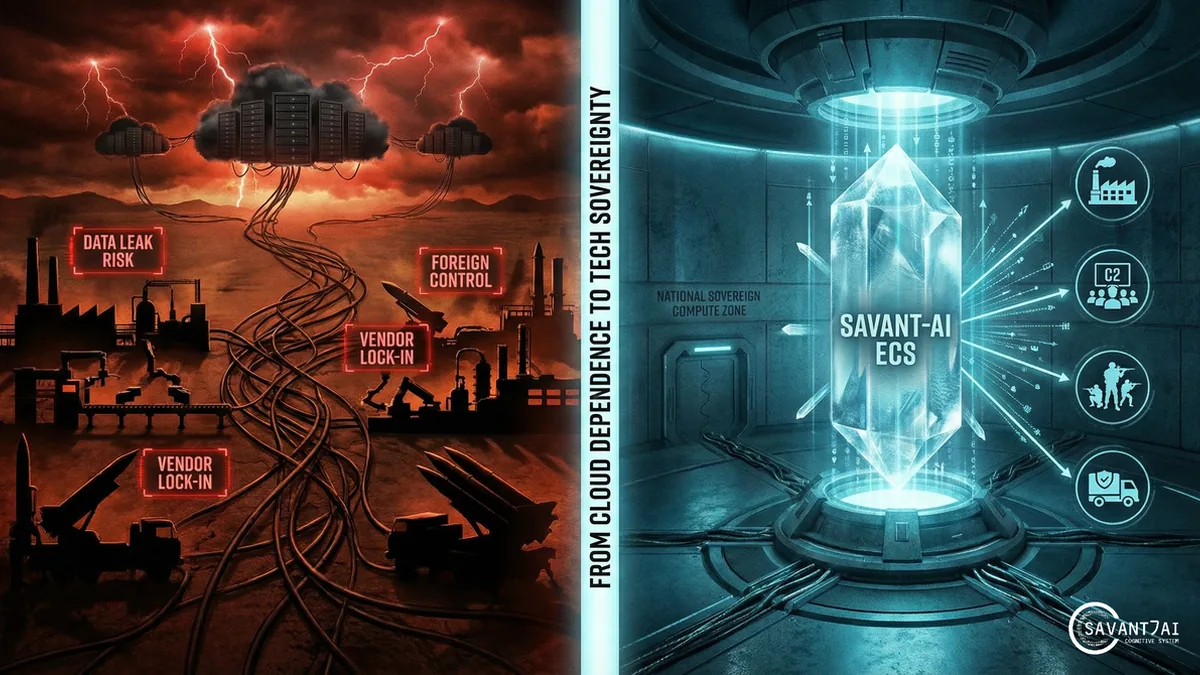
SAVANT-AI and GENESIS-AI are research projects in the inLABs programme. The capabilities described are research goals, not an available product. Project status: inLABs
Literature on the digital economy emphasizes that countries lose not because of a lack of engineers, but because of a lack of their own decision-making elites based on sovereign information infrastructure. The EU talks about "digital strategic autonomy," which is the ability to develop and control key technologies—including AI—on its own territory so that it can "act independently when necessary and cooperate when possible."

The defense industry therefore needs not only factories and production lines, but also its own sovereign AI/BI systems that are not controlled by foreign suppliers. SAVANT-AI is meant to run on-premises, fully air-gapped, as the local “brain” of a defence organisation within national infrastructure and jurisdiction — in line with the EU’s strategic autonomy agenda.
From classic BI to a sovereign cognitive system
Business Intelligence is defined as a set of tools (data warehouses, exploration, decision models, expert systems, AI) aimed at improving decisions and increasing the value of a company. The key is to transform dispersed operational data (ERP, MES, PLM, CRM, etc.) into a coherent knowledge system, rather than just reports.
The SAVANT-AI project takes BI to the cognitive and defence level. The system is meant to:
- create a digital nervous system for defense plants and institutions, linking ERP, MES, PLM, WMS, CMMS, CRM, DMS, and military systems into an agent-based AI ecosystem;
- use Orchestrator Core (including Llama-3 405B), which manages an orchestra of domain agents that understand the language of engineers, logisticians, planners, and officers;
- operate without a “black box in the cloud” – all data, models, and policies remain local and auditable.
In this way the project responds to the call for BI/AI systems not only to report, but also actively contribute to strategic and operational decisions with full control on the part of the operator – which coincides with the EU's idea of tech sovereignty.
Data, "data physics," and local AI infrastructure
The EU classifies AI, semiconductors, and digital infrastructure as key technologies in which dependence on third parties must be reduced, combining productivity with economic security. Experts also talk about "data physics" (Data Gravity): with petabytes of data, it is cheaper and safer to move algorithms to data than to move data to foreign clouds.
The SAVANT-AI project assumes exactly this:
- an on-premises appliance of the NVIDIA HGX B300 class in a full air gap — all AI processes in a domestic data centre, on local data, models and policies;
- Deep Sovereignty mode — critical cognitive operations in separate TEEs on Blackwell accelerators, with the ability to completely cut off external interfaces when working with classified information;
- alignment with EU think-tank recommendations, which advocate the creation of European "Special Compute Zones" and local AI centers for public and critical sectors — SAVANT-AI is meant to be such a local “compute zone” for the military and the defence industry.
Algorithmic sovereignty, security, and "trustworthy AI"
In its approach to AI (excellence & trust), the EU points out that high-risk AI applications must be transparent, auditable, and subject to strong oversight, in line with the idea of "trustworthy, human-centric AI." Research on the risks of AI highlights bias, vulnerability to attacks, and the possibility of decision-making manipulation and cybercrime.
The planned SAVANT-AI architecture starts from exactly these requirements:
- Cognitive Governance Gateway is meant to act as a semantic firewall — filtering not only the content but also the intent of queries, session context, and data class, and enforcing, among other things, complete Internet isolation for confidential and classified information;
- a multidimensional access matrix (RBAC, ABAC, MAC, REBAC, PBAC, RAdAC, Break-the-Glass/Emergency RBAC) is to be built into the cognitive layer so that the system knows not only “what to say,” but also "what not to say to whom";
- real-time AI auditing is meant to record the semantics of queries, models used, agents, data sources, and policies, detect unusual patterns (e.g., social engineering attempts), and automatically switch the system to enhanced security modes.
Such a model—local, auditable, and supervised—corresponds to the EU ideal of "trustworthy AI" in high-risk sectors, rather than global, opaque "black boxes."
The advantage of technical thinking: hidden knowledge and proprietary advantages
In the debate on European and Polish AI, it is repeatedly stated that the goal is not to "catch up with Silicon Valley in generative marketing," but to build our own advantages that are difficult to copy , especially in defense, energy, and finance. Research on data science and competitive advantage shows that the ability to convert dispersed know-how into working systems and processes is key.
The SAVANT-AI project aims to address this on several levels:
- consolidating data from ERP, PLM, MES, WMS, CMMS, CRM, DMS, and military systems into a coherent Corporate Context Buffer and Knowledge Hub;
- capturing the hidden knowledge of experts (the "silver tsunami" phenomenon) in interactions with agents – decisions, comments, and patterns of behavior become part of the organization's cognitive memory;
- creating proprietary domain agents of proprietary domain agents specialized in local procedures, tactics, equipment configurations, and supply chains.
As a result, the defence industry would not only consume AI but also build its own technical thinking in the field of AI, which cannot be easily copied by installing "the same model" elsewhere.
SAVANT-AI + GENESIS-AI: towards a sovereign cognitive infrastructure
The EU points out that AI has become a test of European ambitions in terms of tech sovereignty: without its own capabilities, Europe will be forced to choose between the standards of other powers. It is not just about models, but about the entire chain – from data and computing power to systems and applications implemented in critical sectors.
This is where the SAVANT-AI and GENESIS-AI research projects come in:
- SAVANT-AI is meant to be the cognitive “brain” — integrating data, knowledge, policies, and decisions into a single, sovereign cognitive layer, consistent with national and European raison d'état;
- GENESIS-AI is meant to be a sovereign software factory automating the SDLC — from GENESIS-DOCU to ready containers — and building systems
This duo creates a complete AI sovereignty infrastructure: data and knowledge do not leave the country, decision-making intelligence is local and auditable, and software production capacity does not depend on foreign vendors. In the reality of growing geopolitical tensions and the dynamic development of AI, such infrastructure is becoming one of the key elements of modern defense – precisely in the spirit of strategic autonomy and digital sovereignty as defined by the EU.