SAVANT-AI: Compliance That Keeps Pace with 2026
SAVANT-AI is a research project in the inLABs programme. The capabilities described are research goals, not an available product. Project status: inLABs
Today's regulatory environment is changing faster than ever before. Sanctions imposed by supervisory authorities are increasing, reporting requirements are becoming more stringent, and artificial intelligence is becoming the subject of heightened interest from regulators around the world. At the same time, regulatory compliance teams are expected to perform more tasks, act faster, and bear increasing personal responsibility for potential violations. It is for this environment that we run the SAVANT-AI research project — its goal is a sovereign cognitive system that could become the central hub for regulatory compliance management in large organisations.

From One-Time Counterparty Verification to a Dynamic Risk Map
The traditional model of regulatory compliance management is based on static data. Counterparty documentation is collected once, verification is performed at a specific point in time, and the supply chain is mapped at a specific point in time. In the reality of 2026, this approach is proving insufficient. Sanctions are changing dynamically, shareholding structures are constantly changing, and responsibility for unintentional violations is increasingly falling directly on board members.
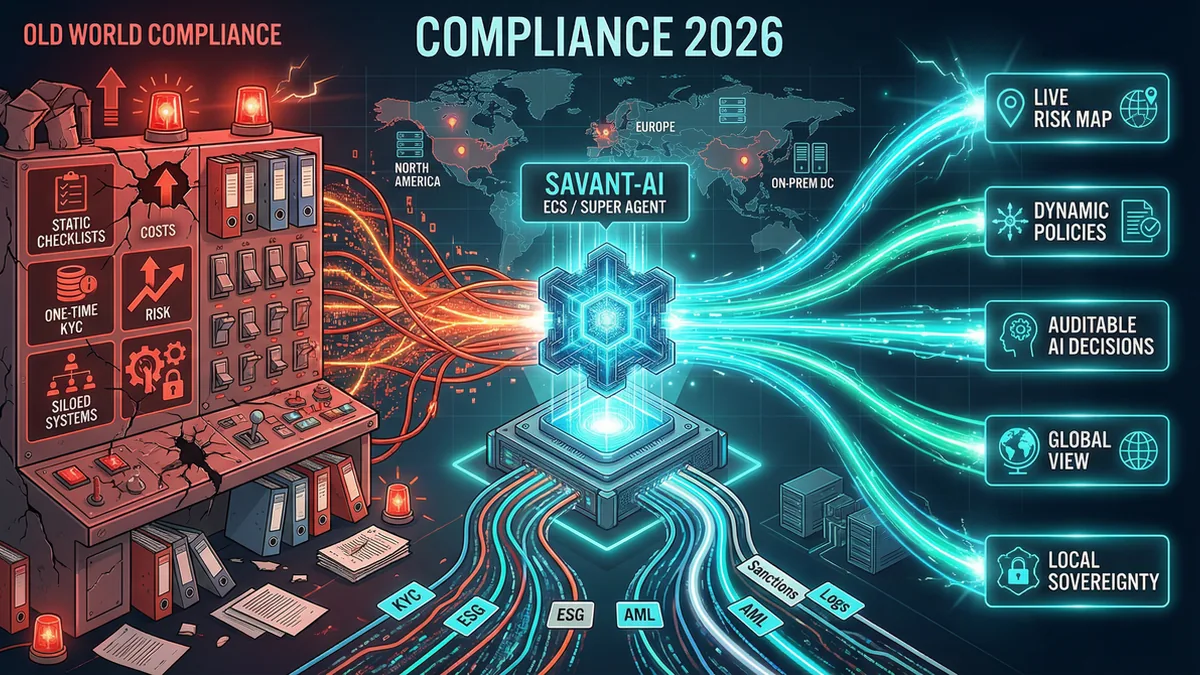
The SAVANT-AI project assumes a different approach. The system is meant to keep an up-to-date picture of the counterparty network, including capital and personal links, and monitor it continuously. Changes in ownership and entity status are to be detected and analysed automatically, without periodic reviews initiated by staff. The result is meant to be a dynamic map of sanctions and reputational risk in a single interface — continuous oversight instead of periodic updates
Truly flexible compliance management
New regulations, changes in reporting thresholds, and additional requirements for sustainability and anti-money laundering mean that procedures written with the assumption of long-term durability become outdated within a few months of implementation. The problem lies not only in a lack of knowledge about regulatory changes, but above all in the lack of a tool that allows new requirements to be quickly translated into specific operational actions.
SAVANT-AI is meant to act as a control layer for compliance processes. Rules and policies would be changed in one place rather than in a dozen applications, and changes in regulatory requirements would translate straight into analysis scenarios, notifications and workflows. Units in different countries could have separate regulatory profiles while sharing the organisation’s nervous system. The aim is for compliance management to stop being a heavy IT project and become a flexible process
Artificial intelligence in compliance – with full oversight and auditability
Artificial intelligence in the area of regulatory compliance is an opportunity to radically accelerate work, but also a new area of risk that requires special attention. The key questions we hear from customers concern the transparency of the system. Organizations want to know how the model made a particular decision and whether they can explain this process to the supervisory authority during an inspection. Another important question is the ability to manage algorithm bias and minimize the number of false positives.
The SAVANT-AI project starts from corporate governance and accountability. Every decision step of the agents and language models is meant to be recorded so that the reasoning path can be reconstructed in an audit. Inputs and outputs are to be versioned and linked to the policies in force at the time of processing. Expert oversight mechanisms are meant to define when a system decision is only a recommendation requiring human approval and when it may run automatically. The goal is AI controlled by the compliance team rather than an impenetrable structure
Fraud detection and digital security – visibility instead of illusions
Today, complex fraud rarely takes the form of a single suspicious transaction that can be easily identified using simple rules. Much more often, it involves subtle patterns of behavior, non-obvious connections between entities, and anomalies in network traffic and the behavior of IT system users. Separate security systems operating in isolation from compliance management systems are not enough, because neither layer sees the full picture.
SAVANT-AI is meant to integrate data from many sources in a single analytics platform: signals from transaction systems, security logs, identity management tools and counterparty registers. The analysis is to combine deterministic rules with anomaly detection models, and the platform is to lead from a warning signal, through risk scoring, to an investigation
Global regulations, local data sovereignty
Large organizations operating in international markets face the complex challenge of reconciling conflicting requirements. They must simultaneously meet different sustainability and anti-money laundering requirements in different jurisdictions. They are required to comply with local rules on the storage and processing of personal data, which may preclude the transfer of information outside a specific geographical area. At the same time, they need to manage risk across the entire group, which requires the aggregation of data from multiple sources.
The SAVANT-AI project is designed to support this multi-level approach. The system is meant to allow separate sets of requirements per jurisdiction and to run in a sovereign model — locally in the customer’s data centre, fully network-isolated, in a defined geographic area. Risk and compliance indicators are to be aggregated at group level without breaching local data-flow restrictions
The human factor – SAVANT-AI as expert support, not a substitute
The most important aspect of the entire system concept is that SAVANT-AI is not intended to replace the teams responsible for regulatory compliance. The system is designed to provide them with additional analytical support and act as the nervous system of the organization, collecting, combining, and organizing data from across the corporate structure. Based on the information collected, it is meant to propose priorities, generate notifications and present response scenarios. Routine activities for action, generates notifications of potential threats, and presents response scenarios for identified risks. Routine activities such as contractor verification, document classification, and periodic report preparation are to be automated.
By design, SAVANT-AI is meant to be the central command post for compliance directors and their teams — a place where information for directors responsible for regulatory compliance and their teams. It is a place where information about identified risks, actions taken, evidence gathered, and the current status of the organization's compliance with applicable requirements is available in a single view.
Who is SAVANT-AI intended for in the area of regulatory compliance?
The greatest benefits could be seen in organisations operating in multiple countries simultaneously, which must operate under different regulatory regimes and sometimes reconcile conflicting legal requirements. The project is particularly relevant to entities to entities subject to intensive supervision by regulatory authorities, including financial institutions, energy companies, critical infrastructure operators, and public sector entities. SAVANT-AI is meant to respond to the needs of organizations where the liability of board members for regulatory compliance violations is real and personal, and the consequences of negligence can be not only financial but also criminal. The project targets entities that want to implement AI-based solutions, but in a sovereign manner, fully controlled and auditable at every stage of processing.