The architecture of sovereign corporate intelligence: why data must remain in the server room in the age of AI
SAVANT-AI is a research project in the inLABs programme. The capabilities described are research goals, not an available product. Project status: inLABs
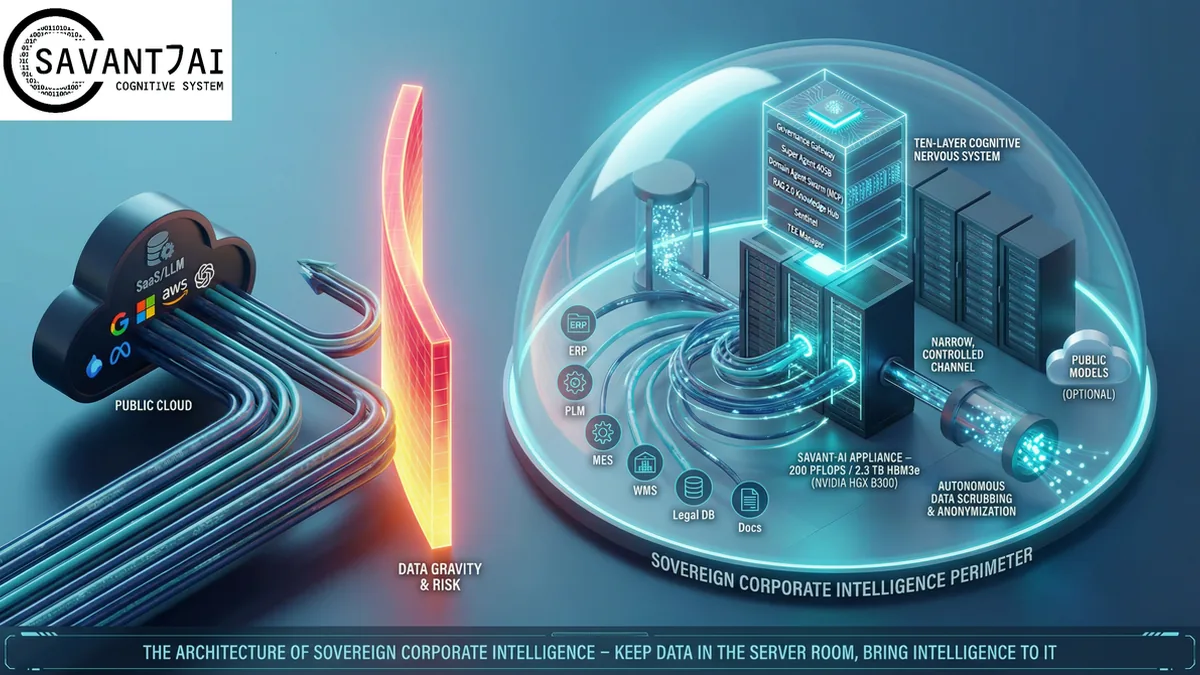
The SAVANT-AI research project is a response to the sovereignty and performance deficits of cloud solutions. The goal is not a “local model installation” but a sovereign Enterprise Cognitive System (ECS) — a digital nervous system for the organisation rather than a SaaS service. The project assumes a dedicated computing unit, full air-gap network isolation, cognitive governance and orchestration of the organisation’s knowledge resources.

Project assumption: computing power close to the data
The SAVANT-AI project assumes a dedicated computing unit of the NVIDIA HGX B300 (Blackwell Ultra) class. It is meant to work where data shows the greatest “inertia” — in the organisation’s data centre, directly alongside ERP, PLM and MES systems.
High computing power (200 PFLOPS) and huge, unified VRAM memory (2.3 TB HBM3e) enable Permanent Model Residency. By design, the system is meant to keep the Super Agent (Llama-3 405B), a team of domain agents and large context windows in memory at the same time — without the latency known from cloud systems and without degrading inference quality through quantisation. Instead of sending petabytes of data to the cloud (Data Gravity), the project aims to bring intelligence to the data and shorten inference latency.
Hardware isolation and Deep Sovereignty Mode
For applications with the highest security requirements, the project assumes physical air-gap isolation and a Deep Sovereignty Mode meant to take protection down to the hardware level:
- TEE (Trusted Execution Environments) enclaves: Critical cognitive processes (e.g., margin analysis, R&D recipes) are performed exclusively within isolated enclaves in NVIDIA processors, which is meant to prevent even system administrators from accessing the data.
- Default Deny: Communication with the Internet is blocked by default. If the policy allows the use of public models, the system launches the Autonomous Data Scrubbing module, which physically replaces sensitive data with synthetic tokens before it leaves the corporate perimeter.
Governance, security, and sovereignty built into the architecture
Unlike assistant systems, the SAVANT-AI project assumes a Total Control paradigm. Security is meant to be the foundation of orchestration logic, not an “overlay”:
- Semantic Intent Filter: Each query is analyzed by the NLU processor for hidden intentions. If the system detects an attempt to extract *Top Secret* know-how, the query is immediately blocked at the cognitive gateway.
- Sentinel Module (Cognitive Guardian): An independent, redundant AI agent that audits the response generation process in real time. It acts like a digital drone scanning communication paths – if it detects a risk of hallucination or compliance violation, Sentinel activates the system Kill Switch.
- Multidimensional Permissions Matrix: the project assumes a combination of several access control models. The system is meant to manage knowledge based on the integration of RBAC (roles), ABAC (session attributes), MAC (confidentiality labels), ReBAC (relationships in projects), and PBAC (business policy logic) models. A key innovation is the RAdAC (Risk-Adaptive Access Control) model, which dynamically modifies the visibility of facts depending on the session risk profile. In critical situations, the system supports “break-the-glass” (BTG) procedures, allowing for temporary, fully auditable extension of permissions to ensure business continuity.
The ten-layer nervous system of the corporation
The planned logical architecture of SAVANT-AI comprises ten specialised cognitive layers:
- Cameleoo UI: Adaptive cognitive interface (3D visualization and knowledge maps).
- Perception and NLU Layer: Understanding of engineering jargon and the organisation’s ontology.
- Governance Gateway: Semantic firewall and perimeter guard.
- Super Agent (Orchestrator Core 405B): Instance of highest logic and synthesis planning.
- Domain Agent Swarm (7 Domains): Specialized agents operating on the MCP standard.
- Identity Mapping Node: Identity Mapping mechanism (ERP/PLM permission inheritance).
- Operational Knowledge Repository (RAG 2.0): Indexing of “dark matter” unstructured data.
- Corporate Context Buffer (KV Cache Pool): Long-term memory of company decision-making processes.
- Sentinel Module (Cognitive Guardian): Redundant audit and AI error mitigation.
- Sovereign Infrastructure Manager: Low-level supervision of TEE enclaves and VRAM resources.
MCP Protocol and Objective Truth Mechanism
One of the project’s goals is to reduce costly point-to-point integrations. Using the Model Context Protocol (MCP), the system is meant to act as a universal bus that queries ERP and PLM systems “live”.
Each response is subject to Reference-First Synthesis rigor – the system does not “generate” content from static memory, but synthesizes it exclusively from hard evidence. Thanks to Deep Citation technology, every number on the screen is an interactive link leading directly to the source (a PDF page or database record), which eliminates hallucinations and builds absolute trust among management.
The economics of knowledge as an asset
An own-infrastructure model can change the profitability structure of AI projects:
- -
- Reducing AI Sprawl: the goal is to consolidate scattered cloud subscriptions into a single point of control and curb uncontrolled OpEx.
The implementation of SAVANT-AI is a transition from passive data archiving to active fact synthesis. It is a strategic choice made by leaders who understand that, in the era of cognitive industrial transformation, true market power belongs to those who have the smartest and most sovereign knowledge about their own business.