Five decision bottlenecks and how an ECS could remove them
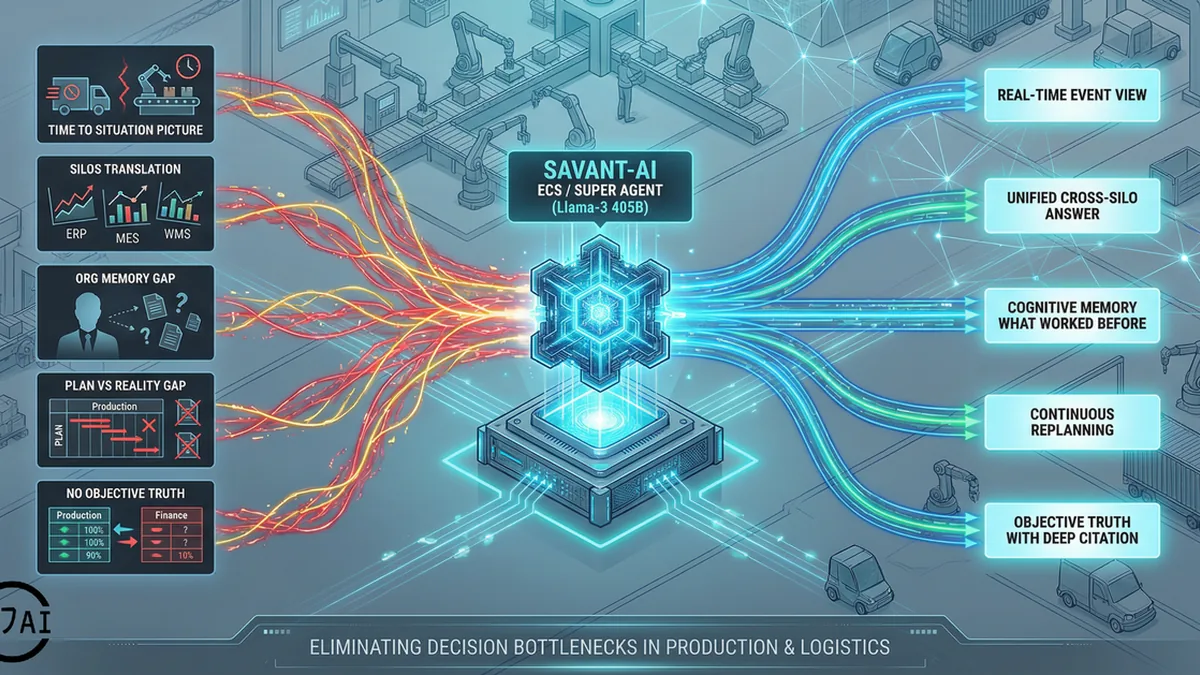
SAVANT-AI is a research project in the inLABs programme. The capabilities described are research goals, not an available product. Project status: inLABs
In modern organizations—from innovative SMB companies to global corporations and public institutions—the main bottlenecks no longer lie solely in machine efficiency or transport capacity, but in the decision-making process itself. The SAVANT-AI project — an Enterprise Cognitive System (ECS) — aims to remove these blockages by turning scattered data from ERP, MES, WMS, PLM, and documentation databases into a single, coherent digital nervous system for the organization.

Bottleneck: time to gather a picture of the situation
When a problem arises—a delayed delivery, line failure, or quality deviation—the first challenge is to compile a reliable picture of the situation from multiple systems. Data is scattered across transactional databases, spreadsheets, and emails, and each of these sources looks at the problem from a different perspective.
SAVANT-AI:
- In real time, it combines facts from operating systems and documents, building a single, contextual "event view."
- It uses the power of Super Agent (Llama-3 405B) to suggest immediately possible action scenarios (e.g., change of plan, rescheduling of transport, adjustment of priorities) instead of leaving the decision at the stage of tedious "report review."
The aim is to shorten the time from event to decision, which affects margins and operational stability.
Bottleneck: manual "translation" between silos
Production, logistics, purchasing, and finance look at the same problem through the prism of their own systems, codes, and indicators. A huge part of the work of specialists is manually "translating" data and concepts between these worlds, which generates delays and misunderstandings.
SAVANT-AI:
- Thanks to its ecosystem of agents and the Model Context Protocol (MCP), it builds a common semantic layer across the entire corporate IT landscape.
- It allows questions to be asked in natural language, and the answers synthesize data from multiple domains into a single message.
The need for a "human translator" between systems disappears – SAVANT-AI translates the languages of silos into a single business picture that is understandable to management and operations.
Bottleneck: lack of structured organizational memory
How failures or unusual orders were actually handled often resides only in the memory of the most experienced experts. When they leave the company (the Silver Tsunami phenomenon), the organization loses years of practical know-how.
SAVANT-AI:
- Implements a cognitive succession process, transforming scattered knowledge—from notes, service reports, and emails—into a digital, sovereign repository of operational knowledge.
- It tells engineers and planners "what worked in the past in similar situations" and warns them about mistakes that have already been made.
In practice, the system acts as the institution's "long-term memory," protecting it from the effects of staff turnover and erosion of expertise.
Bottleneck: the gap between plan and reality
Planning is cyclical by nature, while reality on the production floor and in logistics is constantly changing. Dynamic events cause plans to become outdated faster than they can be manually corrected in ERP systems.
SAVANT-AI:
- listen continuously to signals from MES and WMS systems, on local NVIDIA HGX B300-class infrastructure.
- It proposes dynamic adjustments to plans and order sequences, while showing their real impact on profitability and deadlines.
This makes planning a continuous cognitive process in which AI is an active decision-making partner, not just a recording tool.
Bottleneck: lack of a single objective point of reference
In large structures, "production truth" and "financial truth" often exist in parallel, leading to disputes and decisions based on political power rather than facts.
SAVANT-AI:
- Enforces Objective Truth – every number and recommendation has an unbreakable chain of evidence (Deep Citation technology).
- Provides a single, shared view of the situation for all stakeholders, anchored in source documents.
Management and operations receive a shared "map of reality," which allows for substantive discussion of priorities and builds trust in the actions taken.
Summary
The SAVANT-AI project aims to remove decision bottlenecks through a lasting layer of sovereign intelligence of sovereign intelligence over the entire IT landscape of an organization. For a modern enterprise, this means a transition from reactive firefighting to proactive knowledge management — with a sovereign “corporate brain”.