Why Every Modern Organization Needs a Sovereign "Institutional Brain": An introduction to the SAVANT-AI project
SAVANT-AI is a research project in the inLABs programme. The capabilities described are research goals, not an available product. Project status: inLABs
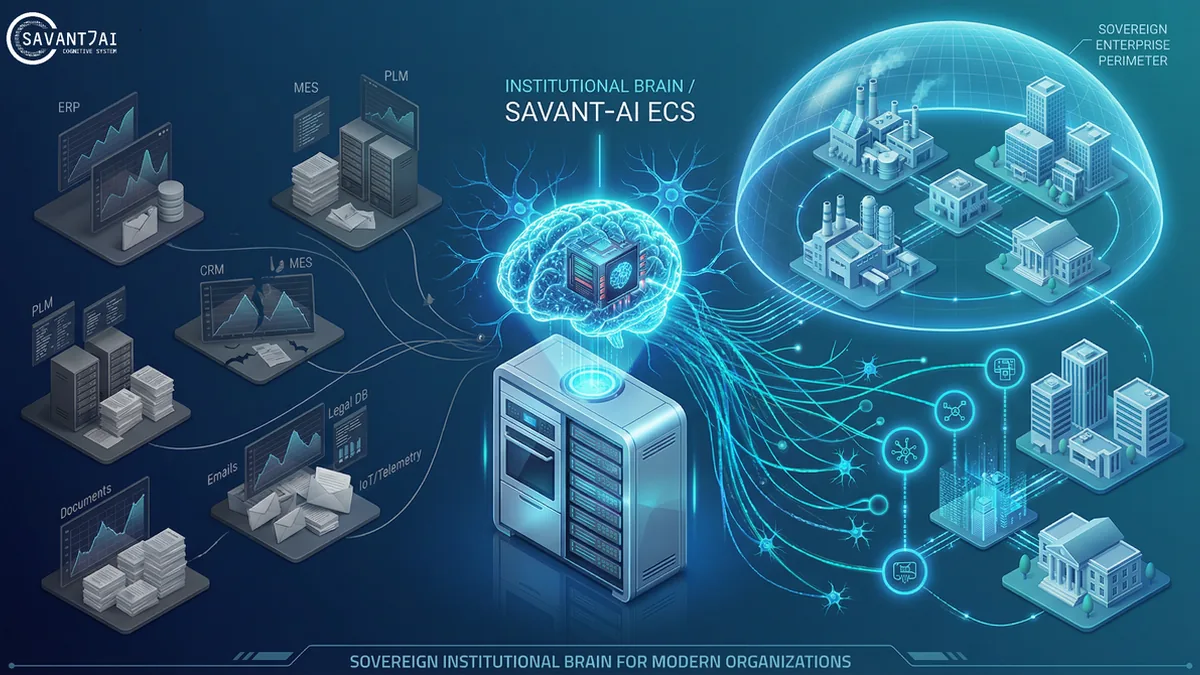
Today's organizations - from innovative SMB companies to public institutions to global corporations - do not suffer from a lack of data, but from a lack of time and cognitive power to turn that data into sound business decisions. SAVANT-AI serves as the sovereign "institutional brain" for your firm: a sovereign Enterprise Cognitive System (ECS) that connects ERP, MES, PLM, legal databases, and dozens of other systems into a single, controllable nervous system for the organization.

Data Is Available, but Decisions Are Lacking: A Problem Addressed by SAVANT-AI
In a typical organization, data is scattered across many specialized systems. Each of them is great "in its own little world," but together they create a maze in which managers and engineers lose time and context:
As early as 2001, IDC estimated that knowledge workers spend about 30% of their day just searching for information — a source of “knowledge debt”.**
- Operating systems speak different languages, requiring manual translation of facts between departments.
- In crisis situations, the time needed to build a reliable picture of the situation becomes a bottleneck that costs real money.
- For smaller entities and the public sector, cognitive succession is a key challenge: protecting against the loss of unique know-how as a result of staff turnover.
The SAVANT-AI project responds to these barriers: it aims to reduce information friction and decision-making inertia in organizations of all sizes.
From archive to living “brain”: the SAVANT-AI ECS concept
For years, IT strategy has focused on passive data archiving. The SAVANT-AI project represents a different philosophy: a move to active fact synthesis. By design, the ECS-class system is meant to:
- return a verified answer rather than a list of documents, but a ready, verified answer, always with Deep Citation technology enabling access to sources.
- use the Super Agent (Llama-3 405B), which acts as the highest logic instance, planning thought processes and orchestrating tasks for domain agents.
- orchestrate knowledge above existing systems rather than replace them knowledge above them using the Model Context Protocol (MCP).
In practice, SAVANT-AI is meant to be a living foundation of intelligence that synthesises facts and suggests decisions to people in every role - from clerks and engineers to CFOs and executives.
How SAVANT-AI Sees an Organization: A Nervous System Instead of a Collection of Systems
The planned logical architecture of SAVANT-AI is a ten-layer nervous system.**
- In the integration layer, MCP agents connected to ERP, PLM, and regulatory databases understand the specifics of their domains.
- The orchestration core breaks down complex questions into subtasks and assembles them into a coherent, auditable recommendation.
- The knowledge layer (RAG 2.0) combines the "dark matter" of data - emails, notes, PDFs - into a single knowledge graph.
- Users interact through the adaptive Cameleoo UI interface, which tailors the form of the response (knowledge maps, 3D visualizations) to the recipient's profile.
Why SAVANT-AI is meant to go further than classic BI and point AI models
Classic BI provides visibility, but does not provide a "nervous system" for decisions. The SAVANT-AI project assumes a difference on three levels:
- From report to synthesis: Instead of static dashboards, interactive natural language dialogue with the ability to immediately drill down into context.
- Orchestration, not monolith: Instead of single models, a swarm of agents working together under the supervision of the 405B model.
- Cross-domain horizon: Instead of siloed optimization (e.g., manufacturing only), a cross-functional view that connects engineering, logistics, finance, and legal.
Sovereign "Brain": Hardware Isolation and NVIDIA HGX B300
A key assumption of SAVANT-AI is full cognitive sovereignty:
- The project assumes a specialised appliance of the NVIDIA HGX B300 (Blackwell Ultra) class with 2.3 TB of VRAM.
- Operation in complete network isolation (air-gap): the organisation’s strategic know-how stays within its perimeter (air-gap): the organization's strategic know-how never leaves its perimeter.
- Critical operations in TEE enclaves (Trusted Execution Environments) enclaves, isolating AI thought processes at the silicon level.
This is a response to data gravity: it is more efficient to bring powerful ECS to the data in a factory or office than to send sensitive information to the cloud.
Governance and Objective Truth: Why You Can Trust This "Brain"
The SAVANT-AI project assumes a reliable and auditable system, which is crucial for the public sector:
- The Cognitive Governance Gateway is meant to act as a semantic firewall, analyzing the intent of queries and enforcing security policies (e.g., RAdAC).
- Factual Grounding mechanisms are meant to ensure that every answer is anchored in source evidence, not in the model's "hallucinations."
- Deep Citation is meant to allow for instant auditing: every word of the system can be verified in the source document with a single click.
From an audit and regulatory perspective, the goal is a transparent decision support system rather than a “black box”.
The economics of an “institutional brain”
Own AI infrastructure turns the unpredictable operating cost of cloud AI (OpEx) into a lasting asset (CapEx):
- Each subsequent use case (new department, process, domain) benefits from the existing, sovereign infrastructure.
:::closing Implementing SAVANT-AI is a strategic shift from data collection to knowledge mastery. It is the choice of leaders who understand that sovereign intelligence is the foundation of security and advantage in the new cognitive era.