Part 2/5: Faster Innovation, Higher Productivity, Lower Costs [AI Software Factory Is a Critical Technology for the EU Economy]
GENESIS-AI is a research project in the inLABs programme. The capabilities described are research goals, not an available product. Project status: inLABs
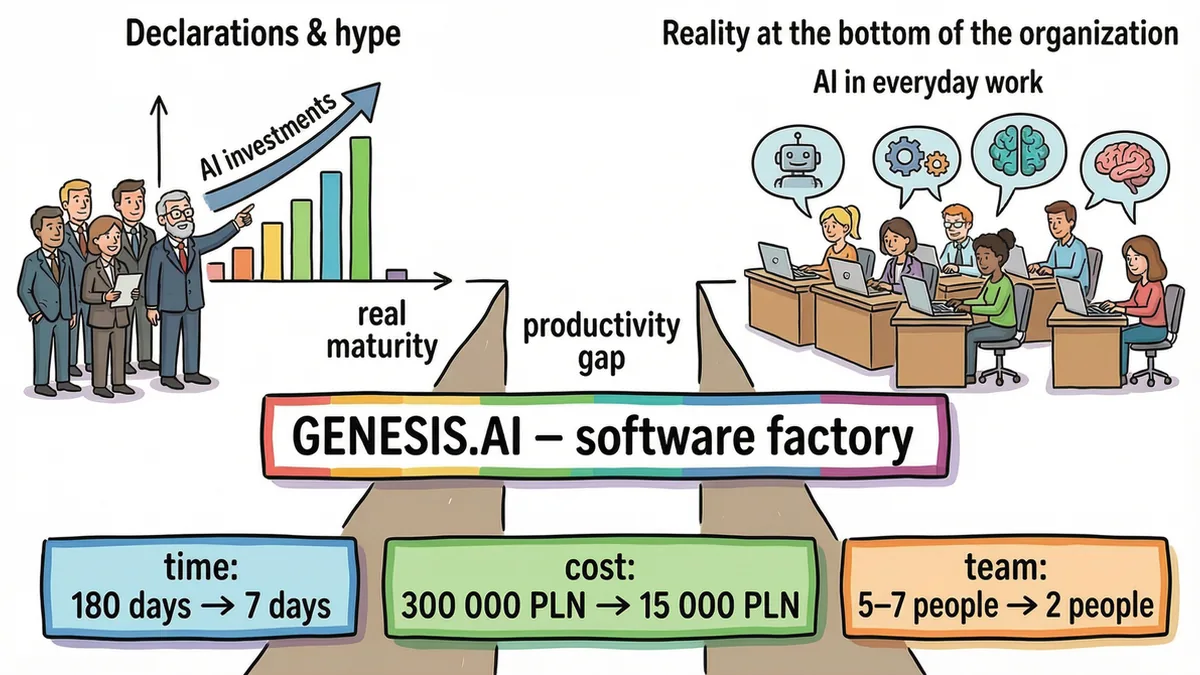
AI status reports show a large discrepancy: almost all companies declare investments in AI and see its enormous productivity potential, but only a fraction of leaders consider themselves truly mature – i.e., those where AI is woven into core processes and delivers measurable business results. In practice, this means that many organizations are paying for AI but are still waiting to see it translate into time, cost, and throughput savings for their teams. At the same time, labor market research shows that the transformation is already underway "at the bottom" – as many as one in four employees use AI tools at least several times a week, often on their own initiative, while management boards still systematically treat AI as a series of experiments.
The gap between people’s readiness and processes
This creates a gap: employees are ready, the tools exist, but there is a lack of systems that can transform this energy and individual productivity gains into a lasting change in the way entire processes operate. The GENESIS-AI project addresses this problem at its most critical point — software development. Traditionally, building a dedicated web application takes months (analysis, design, implementation, testing, corrections, deployment), and it is easy to rewrite temporary solutions along the way. The GENESIS-AI project assumes a factory: from well-described requirements to a working application, with a full quality and security path.

Software development economics in numbers
In numbers:
- the time to produce a typical web application prototype drops from approx. 180 days to 7 days,
- the unit cost from PLN 300,000 to approx. PLN 15,000 – a reduction of 90-95% with a comparable range of functions,
- the same IT team can handle significantly more initiatives – instead of 5–7 people per project, all you need is an analyst + a technical person supervising the work of agents responsible for code, testing, and integration.
This is exactly the effect we are talking about when we refer to the next wave of productivity from generative AI: decoupling costs and the number of projects from the number of available developers while maintaining enterprise-class standards. If even a small share of the EU’s millions of ICT specialists used an AI software factory, the productivity effect — measured in additional IT projects and shorter time-to-market — would be significant for the internal market.
Automating tasks, not people
The debate on AI reveals two extreme views of the labor market: on the one hand, warnings about the strong impact of automation on entry-level positions, and on the other hand, emphasis that there is no "job apocalypse" and that the current wave is another stage of creative destruction – the pace of skills adaptation is becoming crucial. In such a world, platforms that automate tasks rather than people have a real advantage—they allow repetitive tasks to be taken over, while retaining full decision-making power and a place for humans as the ultimate decision-makers.
The GENESIS-AI project aims at a factory for solutions that relieve people of entry-level work (document analysis, integrations, simple workflows) which, with built-in time, cost and quality metrics, would show the hard productivity KPIs that management, investors, and regulators expect. Such a radical change in the economics of software development translates directly into significant economic potential in the EU internal market – it lowers the barrier to investing in software and speeds up innovation in the EU’s strategic sectors.