Part 5/5: Catalyst for a Sustainable and Resilient Digital Economy [AI Software Factory Is a Critical Technology for the EU Economy]
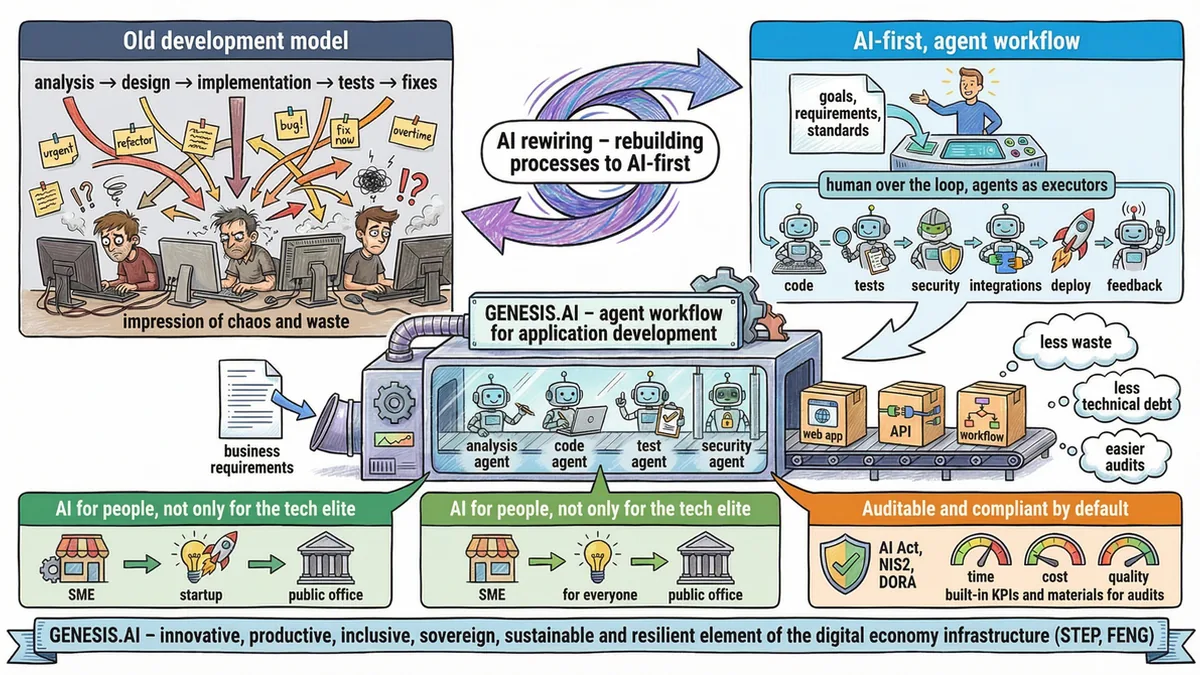
GENESIS-AI is a research project in the inLABs programme. The capabilities described are research goals, not an available product. Project status: inLABs
Reports on "AI rewiring" emphasize that the next stage is to rebuild operating models in the spirit of "AI-first": processes are designed from the outset with the assumption that the first executor is an AI system or network of agents, and humans are above the loop, correcting strategy, priorities, and quality.
AI-first development
The GENESIS-AI project applies this paradigm to development:
- the whole application development process is to be an agent workflow,
- humans define goals and requirements, verify results, set standards,
- agents perform repetitive, technical work while monitoring testing and security.
From the perspective of sustainability and digital resilience, this means:
- less waste – less rewriting, less time "burned" on repetitive tasks,
- less technical debt – standardization of architecture, technology stack, and quality metrics,
- easier audits and updates – universally understandable code, repeatable testing and security pipeline.

A tool built into everyday work
Added to this is the organizational aspect: recent studies show that employees are more ready for AI than leaders – they are eager to adopt it, but they need clear structures, training, and tools built into their daily work. An AI software factory such as the one we research in the GENESIS-AI project could become one of those tools — instead of an abstract “AI strategy”, a concrete system that builds and updates software every day to repeatable standards.
A lasting part of the digital economy’s infrastructure
In the macroeconomic debate, AI is presented as a source of trillions in additional productivity, but with the parallel risk that the benefits will be consumed by a narrow technological elite and capital owners. This is leading governments and regulators to increasingly ask not about the number of GPUs, but about how widely the effects of AI implementations will spread, how they will affect the middle class and young people entering the labor market. As a result, there is growing demand for AI solutions that are auditable, explainable, and built into regulatory frameworks by default, rather than being a "hack" that circumvents existing rules.
The GENESIS-AI project aims to meet these expectations with a solution factory with built-in value metrics — time, cost and quality — and evidence for audits required by the AI Act, NIS2 and DORA. If the research confirms the assumptions, such a factory could become a lasting part of the digital economy’s infrastructure:
- innovative – multi-agent, GSEF, generative software engineering,
- productive — meant to cut development time and cost,
- inclusive — meant to level the playing field for SMEs and startups,
- sovereign – developed and controlled in the EU, without vendor lock-in,
- sustainable and resilient — meant to reduce waste and strengthens control over critical processes.
This is the type of technology that can serve the innovation, competitiveness, resilience and digital sovereignty of the European economy.