Part 3/5: Digital Sovereignty and Strategic Technological Autonomy [AI Software Factory Is a Critical Technology for the EU Economy]
GENESIS-AI is a research project in the inLABs programme. The capabilities described are research goals, not an available product. Project status: inLABs
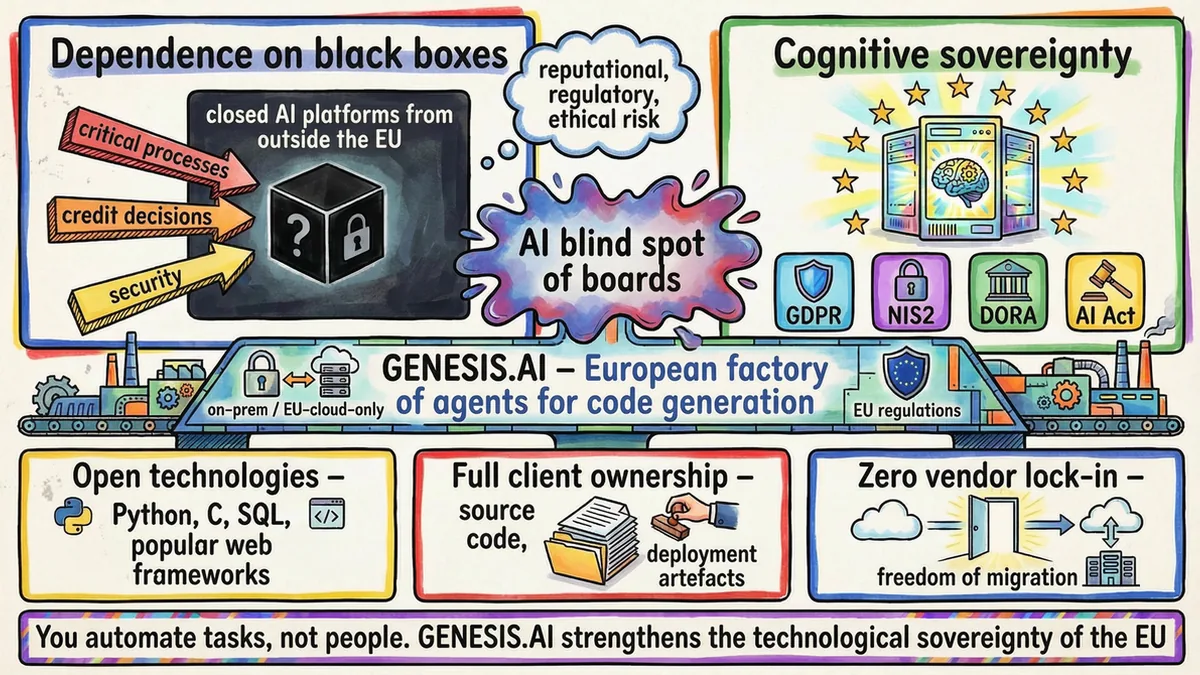
Parallel to the discussion on productivity, there is a growing debate about the risk of becoming too dependent on external AI suppliers. Analyses for management and supervisory boards even point to a "sticky spot": companies see reputational, regulatory, and ethical risks, but often lack a strategy for the most important question – what will happen if we base critical processes entirely on closed, foreign platforms over which we have no real control?
The issue of agents only reinforces this: if the entire logic of processes – from credit decisions to infrastructure security – is embedded in black boxes outside the EU, digital sovereignty becomes a fiction. That is why it is so important that key agent technologies – especially those that affect digital infrastructure such as software development – are developed and maintained where they will be implemented.

Sovereignty of the software and cognitive layer
The current infrastructure boom—gigawatt data centers, growing energy and water consumption, tensions around local communities—is turning data centers into the new "heavy industry" of the digital economy. Building their own hyperscale data centers is not a realistic option for most countries and companies, which is why another dimension of AI sovereignty is emerging: sovereignty at the software and cognitive layer.
European jurisdiction and full code ownership
The GENESIS-AI project assumes this condition — development under European jurisdiction, in line with GDPR, NIS2, DORA, and the requirements of regulated sectors, and operation both in a fully on-premises model and in an EU-cloud-only variant, in cloud regions subject to European regulation and supervision. The second key element is the ownership and portability model:
- code is to be generated in standard technologies — Python, C, SQL and popular web frameworks in standard technologies (Python, C, SQL, popular web frameworks),
- the customer is to receive the full, readable source code and deployment artefacts the full, readable source code and deployment artifacts,
- no closed runtime the system cannot work without your own closed runtime, without which the system will not work.
Such a model is meant to eliminate vendor lock-in at the code level – the organization can maintain solutions on its own or collaborate with any partner, migrate between cloud and data center infrastructures without rewriting the system, and treat the agent-based software factory as a tool rather than a cage.
Your own agent capability instead of a single ecosystem
In the context of warnings about the "AI blind spot," which emphasize the need for conscious decisions by management in the area of critical technologies, the GENESIS-AI project aims to show how to close this gap: instead of relying on a single external ecosystem, the organisation builds its own agent capability to generate code that is fully compliant with European regulations and standards. GENESIS-AI thus strengthens the EU's technological sovereignty in the area of AI for software development, reducing dependence on solutions from outside the EEA Such a factory would strengthen the EU’s technological sovereignty in AI for software development and reduce dependence on non-EEA solutions, in line with the AI Act framework.