Part 4/5: Leveling the Playing Field for SMEs and Startups [AI Software Factory Is a Critical Technology for the EU Economy]
GENESIS-AI is a research project in the inLABs programme. The capabilities described are research goals, not an available product. Project status: inLABs
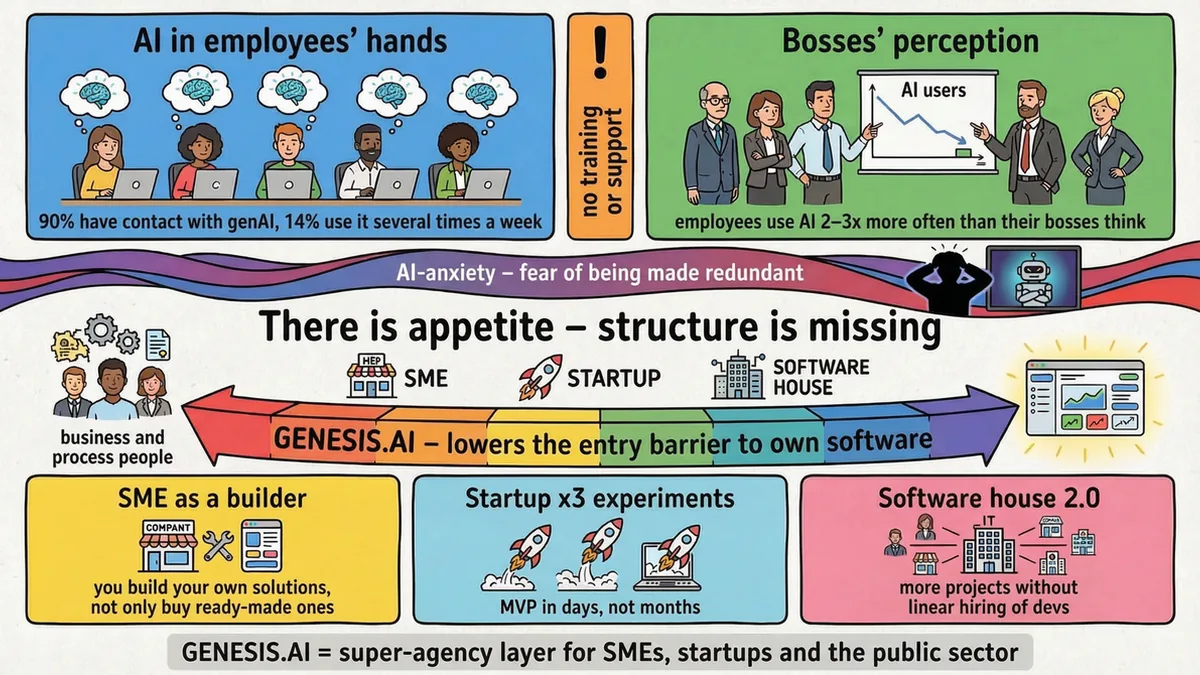
McKinsey’s report “Superagency in the workplace” (January 2025) paints an interesting picture: 94% of employees are familiar with genAI tools, and 13% use them for more than 30% of their daily work — three times more than executives estimate (4%). Nearly half (48%) want more formal training and see it as the best way to increase AI use.

A lower entry barrier for SMEs and start-ups
This means that people have the appetite and readiness, but there is a lack of meaningful, structural ways to use AI in processes that matter to the business – especially in SMEs, where there are no R&D departments or AI strategy teams. The GENESIS-AI project aims to lower the entry barrier exactly where SMEs and start-ups struggle most – in accessing good development teams and in the cost of their time.
Instead of "you need 5–10 developers to build a meaningful application," we set the bar at "you need people who understand your business and can describe the processes – the agents will take care of the rest." This fits perfectly with the thesis that the future belongs to builders, not just tool buyers:
- SMEs could build their own solutions in an AI software factory instead of only buying off-the-shelf applications that do not fit local processes.
- A startup can test several product concepts within the same budget – because creating an MVP takes days, not months.
- A local software house can serve more customers without linearly hiring more programmers, because it outsources repetitive, craft-based tasks to the platform.
Your own “superagency” layer
In this context, an AI software factory would be not just a tool for reducing development costs but a way for SMEs and start-ups to build their own “superagency” layer: people with an understanding of the domain become directors of the software factory, rather than just customers of external suppliers. As a result, the benefits of AI are not concentrated solely in a few large corporations – they spread more widely to local companies, software houses, and the public sector, which can finally prototype solutions at a pace similar to that of Big Tech.
This supports SME competitiveness and innovation across the EU — not only in the largest entities, but also in regions and sectors previously excluded from advanced IT process automation.