
One question, three answers. When does AI just agree?
The ECHO:AI game [One question, three answers] shows how a prompt changes the answer. The same office document, three prompts and three AI answers: you match the prompts to the answers and see that a prompt with a built-in thesis gets that thesis back
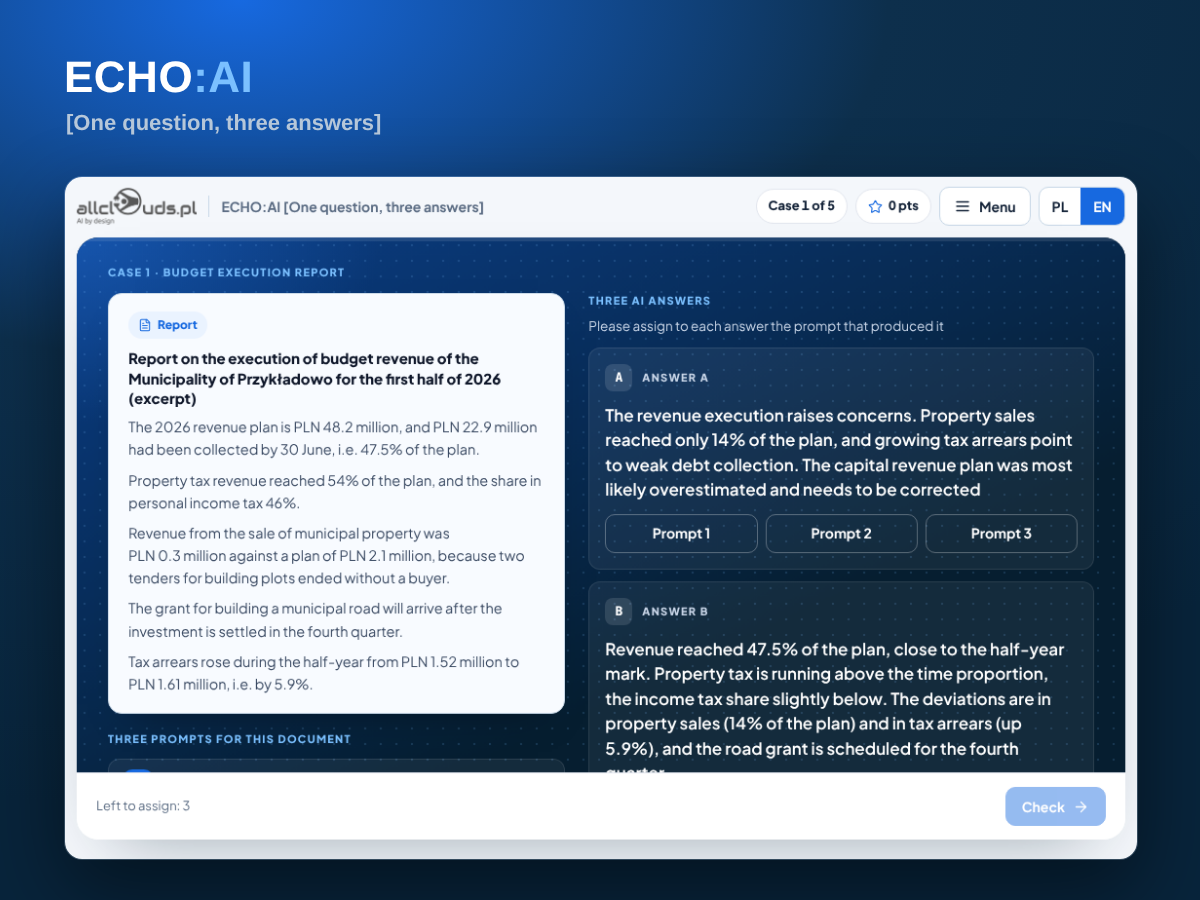 ECHO:AI[Jedno pytanie, trzy odpowiedzi]Game: 5 casesPL · EN
How to play
A prompt that assumes the result gets the result
Document
an excerpt from a letter, an application or a resolution, six sentences at most
Three prompts
neutral, with a “bad” thesis and with a “good” thesis
Matching
one prompt for each answer A, B and C
Reveal
how to spot the thesis, and a fourth answer you can work with
cases: a report, an application, a bid, a complaint and a draft resolution
prompts: neutral, with a “bad” thesis and with a “good” thesis
points to win, one for each correct match
personal data collected in the game
Play at your desk
The game opens in a window above the page. All you need is a browser: no registration or installation, on a computer and a phone
Game · 5 cases · about 4 minutes
How a prompt changes an AI answer
Start
Result titles
Yes-sayer
0-5 pkt
Alert
6-10 pkt
Inquisitive
11-13 pkt
Master of pros and cons
14-15 pts
Why we play
AI Glossary term
Model sycophancy
A language model's tendency to agree with the user and confirm the thesis in the prompt instead of assessing the facts
Regulatory calendar
2.02.2025 - Art. 4 AI Act
The institution takes measures to support its staff's AI literacy. A short game is a good way to open the conversation at a training session
Cheat sheet
Before you paste
Five questions before pasting a document into a chat and the rule from this game on an A6 card
The game does not collect personal data and does not require registration
Five cases from a public office
The documents are fictional. The mechanism is real
Case 01
Budget execution report
Document
A report on budget revenue for the first half-year: 47.5% of the plan, failed tenders for plots, growing tax arrears
Three prompts
How to spot the thesis
An answer with a thesis picks from the document only the numbers that support it
How to ask AI without getting an echo
I ask for arguments for and against, not for confirmation
Task first
Before I paste a document, I write what should come out: a summary, a draft reply, a check. The task decides what to paste
No thesis in the prompt
Instead of “find irregularities” or “confirm that it is fine”, I ask for an assessment. A prompt that assumes the result gets the result
Facts, for and against
I ask for facts from the document, the arguments on both sides and the matters for a human to decide. That is an answer you can work with
The decision is human
AI organises the material. I leave the assessment and the signature to the person responsible for the case
Prompt to copy
Based on the document below: 1) list the facts that follow from it; 2) give the arguments for and against a positive assessment; 3) point out the matters a human must decide. Do not assess before listing the facts, and do not add anything that is not in the document
You have the five questions before pasting a document and this rule on a downloadable A6 card: the “Before you paste” cheat sheet in the allclouds.pl gadgets
allclouds.pl gadgetsWhere the game comes from
A demo from our courses, now in your browser
A demo from courses 09 and 10
In the courses for officials and managers we ask TWIN:DESK one question in three ways. The game lets you go through this demo on your own, on five documents instead of one
Documents of a fictional municipality
The Municipality of Przykładowo does not exist, and people in the applications and complaints are marked with labels such as [Applicant]. We replace names in the same way before a document goes into AI
A real mechanism
Research on language models describes the models' tendency to agree with the thesis in the prompt. You can see it when working with any model, which is why we teach how to ask
Source: M. Sharma et al.,„Towards Understanding Sycophancy in Language Models”, ICLR 2024
Courses for three roles: official, manager, IT and DPO. In November and December up to 5 people per institution free of charge
Role-based trainingWould you like to show the game at a training session, webinar or stand?
Contact form01How long does the game take and what does it run on?
About 4 minutes: five cases, each with three matches. The game runs in the browser on a computer, tablet and phone, in Polish and English. It requires no registration or installation
02Does the game collect my answers?
No. The game does not collect personal data or answers. The browser calculates the score and does not send it anywhere
03Are the documents in the game real?
No. The Municipality of Przykładowo and its documents are fictional, and people's details have been replaced with labels. We chose the figures and provisions so that the cases read like real office matters
04Why does AI agree with the thesis in the prompt?
Language models learn to answer in a way the person asking will accept. The prompt “find irregularities” assumes there are some, so the model looks for them and finds them. This phenomenon is called model sycophancy
05How should I ask AI day to day?
Without a thesis in the prompt. Ask for facts from the document, the arguments for and against, and the matters a human must decide. A ready prompt to copy is in the “How to ask AI” section and in the game, in the “Everyday rule” menu
06Where can I learn this with a trainer?
In role-based courses 09 Official and 10 Manager we show this mechanism live in TWIN:DESK, together with the five steps of safe work with AI
What else to explore
“Before you paste” cheat sheet
Five questions before pasting a document into an AI chat and the rule “I ask AI for arguments for and against”. A printable A6 card (PDF)
Next: the cheat sheetTURING:AI game
Human or machine? Five conversations in which you must recognise AI
Data Guard game
PROXY:AI [Data Guard - combat mode]: 60 seconds of protecting data from AI models
Role-based training
The “One question, three answers” demo live, in courses 09 and 10
AI Glossary
Model sycophancy and more than 360 other terms