
Same horse, different harness. When does an AI model become an agent?
The UPRZĄŻ:AI [Same horse, different harness] game shows how much depends on what surrounds the model. Galop the horse is an AI model: in three jobs he runs once without a harness and once in the harness you put together from 6 parts. You will see the results of both runs side by side
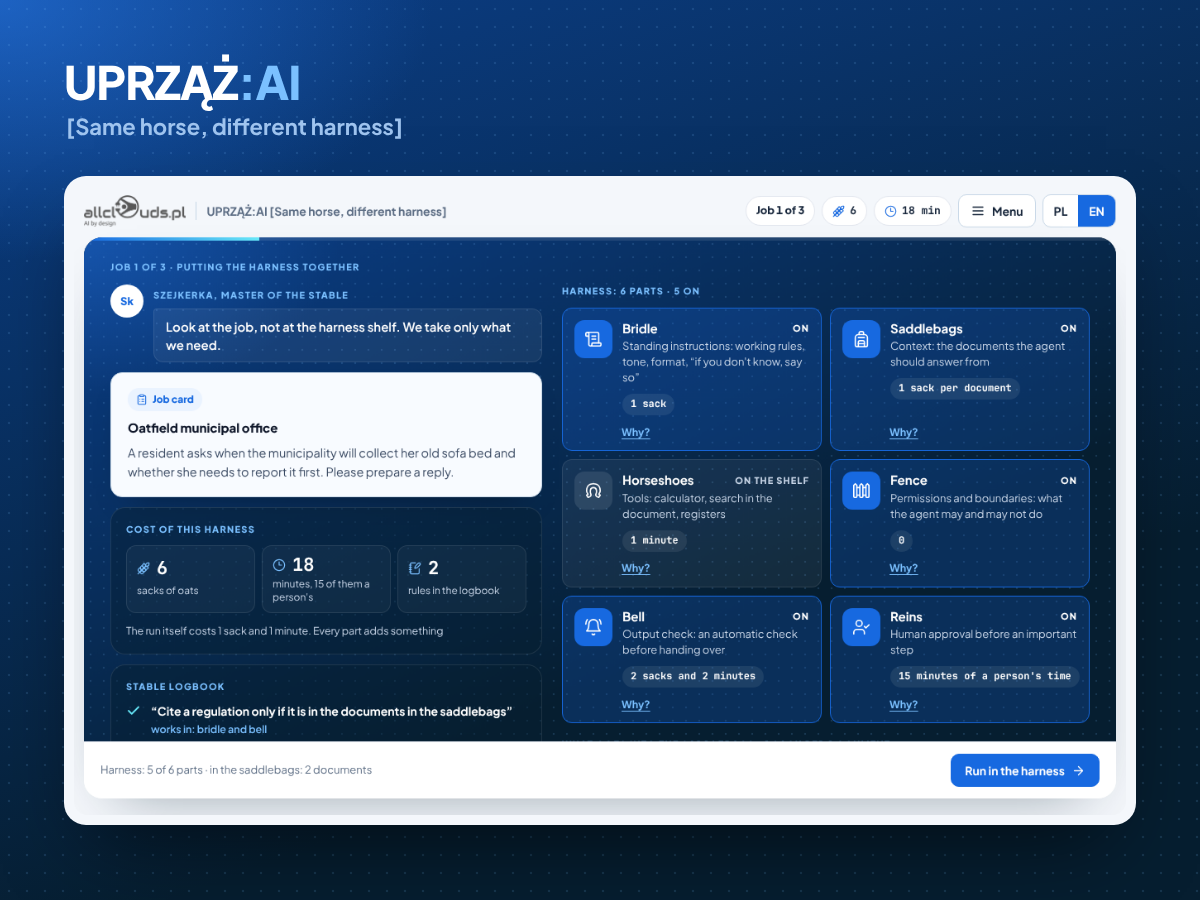 UPRZĄŻ:AI[Same horse, different harness]Game: 3 jobsPL · EN
How to play
Same model. Different harness
Job
the job card and the documents in the stable
Run without a harness
Galop answers in a minute, and after a slip: shouting or a rule in the stable logbook
Harness
6 parts: each fixes a different error and each has a cost
Results side by side
accuracy, time, oats and slips before and after the harness goes on
jobs: a resident's letter, an offer from the price list and a lease summary
parts of the harness: bridle, saddlebags, horseshoes, fence, bell and reins
points: accuracy up to 50, safety up to 30, savings up to 20
personal data collected in the game
Play it yourself
The game opens in a window above the page. All you need is a browser: no registration or installation, on a computer and a phone
Game · 3 jobs · about 8 minutes
How the harness changes the work of an AI model
Start
Score titles
Stable Hand
0-39 pts
Coachman
40-69 pts
Master of the Horse
70-89 pts
Team Master
90-100 pts
Why we play
AI Glossary term
Agentic loop
The way an AI agent works when it picks its next actions itself: it plans, reaches for knowledge, calls tools and checks the result
Regulatory calendar
2.02.2025 - Article 4 of the AI Act
An organisation takes measures to support its staff's AI literacy. A short game is a good way to open a conversation about agents
Cheat sheet
The harness in 6 parts
6 questions before you deploy an agent and the rules from the stable logbook on an A6 card
The game collects no personal data and needs no registration
Three jobs
The jobs are fictional. The mechanism is real
Galop's accuracy in job 01: without a harness and in the right harness. Slips: 2 → 0
Job 01
A reply to a resident's letter
Job card
Oatfield municipal office. A resident asks when the municipality will collect her old sofa bed and whether she needs to report it first
Without a harness
Galop answers in a minute, but makes up a regulation and sends the letter himself
The right harness
Horseshoes are not needed: nothing is calculated or looked up in a register here
Results side by side
18 minutes instead of one, 15 of them a person's. Slower, but the letter tells the truth and carries a signature
The harness in 6 parts
An agent is a model in a harness: with standing instructions, documents, tools, boundaries, output checks and a person who approves important steps. The harness matters for the quality of its work as much as the model does
Each part fixes a different error and each has a cost
Bridle: rules before the start
Standing instructions tell the agent how to work: what tone to use, what form the output takes and what to do when information is missing. Without them the agent guesses. Instructions should be short and specific, because long ones become a load in themselves
Saddlebags: the right documents, and only those
An agent with documents answers from sources, not from memory. More is not better: models make worse use of information in the middle of a long text (source), and reliability falls as the input grows longer (source). So the agent gets the case file, not the whole archive
Horseshoes: the calculator calculates, search searches
Language models struggle with arithmetic and looking up facts, and tools improve their results (source). A tool works out the total in the offer, and search finds the clause in the lease
Fence: only the permissions that are needed
Harmful agent actions have three causes: too much functionality, too many permissions and too much autonomy. A tool that reads e-mail should not be able to send it (source)
Bell: a check before the output leaves
An automatic check compares the output with the sources: is the cited regulation in the documents, do the prices come from the current price list, does the total add up
Reins: a person where a decision has consequences
A person approves sending, posting or deleting. Oversight must be commensurate with the risk (Article 14 of the AI Act), so a note that a person reads anyway only needs an automatic check
6 questions before you deploy an agent
1) Bridle: does the agent know its working rules and what to do when it does not know something?
2) Saddlebags: does it have the right documents, and only those?
3) Horseshoes: does it calculate and search with a tool, not from memory?
4) Fence: what must it not do?
5) Bell: what do we check automatically before the output moves on?
6) Reins: where does a person decide?
Stable logbook: a rule instead of shouting. A model does not remember a telling-off between tasks, and a rule added to the harness works in every following task
PlayThe “Harness in 6 parts” cheat sheet: 6 questions and the rules from the stable logbook on an A6 card to download
allclouds.pl gadgetsWhere this game comes from
The “Polish AI harness” series, now as a game
The “Polish AI harness” series
An AI model has the strength of a horse, but the harness decides where it goes. The blog series describes the harness from three sides: technology, people and law. The game lets you put it together yourself
Fictional jobs
The Oatfield municipal office, The Hoof wholesaler and the lease at 7 Stable Street do not exist. Without real regulations, prices and companies, the game will not age when the law changes
A real mechanism
In February 2026 a team of developers changed only the harness of their agent. With the same model, its Terminal Bench 2.0 score rose from 52.8% to 66.5%. The numbers in the game illustrate this mechanism and are not measurements
Sources: Terminal Bench 2.0: same model, different harness, 17.02.2026; “How good is your harness?”, ICML 2026; “Lost in the Middle: How Language Models Use Long Contexts”, TACL 2024; “Context Rot: How Increasing Input Tokens Impacts LLM Performance”, 14.07.2025; “Toolformer: Language Models Can Teach Themselves to Use Tools”, 2023; LLM06:2025 Excessive Agency, security guidelines for applications built on language models; Article 14 of Regulation (EU) 2024/1689, the AI Act
The “Polish AI harness” series on the blog: technology, people and law in three parts
Read the seriesWould you like to show the game at a training session, a webinar or a stand?
Contact form01How long does the game take and what does it run on?
About 8 minutes: a start quiz, three jobs, each without a harness and in a harness, and a finish quiz. The game runs in the browser on a computer, tablet and phone, in Polish and English. It requires no registration or installation
02Does the game collect my answers?
No. The game does not collect personal data or answers. The browser calculates the score and does not send it anywhere
03Are the jobs in the game real?
No. The Oatfield municipal office, The Hoof wholesaler and the lease at 7 Stable Street are fictional, as are the regulations and prices in the documents. The numbers in the results illustrate the mechanism and are not measurements
04How is an AI agent different from the model itself?
An agent is a model in a harness: with standing instructions, documents, tools, boundaries, output checks and human approval. The same model can be a chat or an agent. What makes the difference is what surrounds it
05Do more documents give a better answer?
Not always. Models use information at the beginning and end of a long text best, and the middle worse. So the agent gets the case file, not the whole archive
06Where must a person approve an agent's work?
Where the output leaves the organisation, commits it or moves money. When the output stays inside and a person reads it anyway, an automatic check is enough
What else to explore
The “Harness in 6 parts” cheat sheet
6 questions before you deploy an AI agent and the rules from the stable logbook. A printable A6 card (PDF)
Next: cheat sheetPolish AI harness
A blog series in three parts: technology, people and law
ECHO:AI game
One question, three answers. When AI just agrees
SAIE products
TWIN:DESK, PROXY:AI and the CDF methodology: a harness ready to work in your organisation
AI Glossary
Agentic loop and over 360 other terms